Magazine
September-October 2026
September-October 2026
Volume: 114 Number: 5
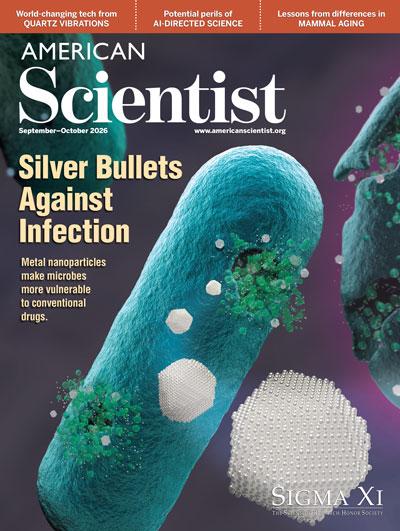
Antibiotic resistance has become a major problem in healthcare, and it is rendering some of the most powerful drugs ineffective. In “Nanoparticles Versus Superbugs,” José Rubén Morones-Ramírez describes how antimicrobial metal nanoparticles could provide an alternative treatment. Silver nanoparticles attack microbes in multiple ways, including perforating their cell membranes (on the cover) to allow cellular material to leak out (green), disrupting crucial metabolic processes, and generating damaging oxidizing agents. By overcoming key defenses of drug-resistant bacteria, silver can also make superbugs more vulnerable to conventional antibiotics. Meanwhile, gold nanoparticles are able to carry short strands of DNA inside bacteria, where they help to silence genes responsible for drug resistance. If these approaches succeed in clinical trials, they could lead to a new generation of antibiotic medicines. (Cover image by Janet Iwasa.)
In This Issue
- Astronomy
- Biology
- Chemistry
- Communications
- Computer
- Engineering
- Environment
- Ethics
- Evolution
- Physics
- Policy
- Psychology
- Technology
On the Aging of Species
Christine J. Charvet
Evolution
Research into comparative aging in humans and other primates is offering clues about diseases, development, and evolution.
Nanoparticles Versus Superbugs
Jose Ruben Morones-Ramirez
Engineering
Minuscule specks of silver and gold could offer new weapons in the fight against antibiotic-resistant microbes.
A Lack of Horsepower
Lee Alan Dugatkin
History of STEM
The Great Epizootic ground cities to a halt, revealing the degree to which 19th-century urban life relied on equine labor.