
This Article From Issue
September-October 2026
Volume 114, Number 5
Page 312
FIERCE COUNTRY: The Untold Story of Three Women Who Ignited America’s Love for the Wild. Heather Hansman. 320 pp. Hanover Square, 2026. $30.99.
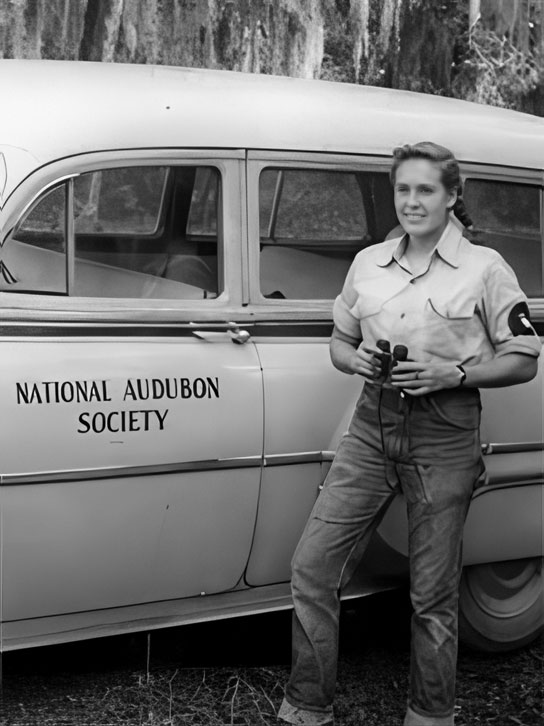
Wikimedia Commons
To paraphrase Wallace Stegner, America’s “best idea” was the protection of culturally and scientifically significant public landscapes through the National Park System, Forest Service, and Bureau of Land Management. The people responsible for this idea and its upkeep—figures such as Teddy Roosevelt, Edward Abbey, Wallace Stegner, John Muir, and John Wesley Powell—have been lionized among lovers of open space, conservation, and outdoor recreation. For people like Fierce Country author Heather Hansman and myself, this cast of role models spurred physical moves and careers based on the wide-open spaces of the American West. But there is a problem with this story: These role models are all men.
This issue is at the core of Hansman’s Fierce Country: The Untold Story of Three Women Who Ignited America’s Love for the Wild. In this book, she follows the lives of three overlooked women within this category of outdoor heroes. Through the stories of these women, she embeds their work in the worlds of outdoor recreation, nature writing, ecology, and environmental philosophy. Hansman unpacks who gets to have outdoor experiences, who wants to have these experiences, and who is “considered capable, self-reliant, and brave.” The author ties her characters into the well-trodden narrative of extraction versus conservation, but provides analysis on much more throughout her text.
Ad Right
The book is organized around the lives of three significant 20th century outdoorswomen and environmental thinkers: Colorado River guide Georgie White, writer and climate scientist Anne LaBastille, and ski mountaineer and environmental philosopher Dolores LaChapelle. Hansman uses the lives of these three characters to discuss the experience of women in the river running industry, scientific fields, and intellectual debates, but also in the relationship between recreationists and land management. She also explores topics such as psychology, environmental history, and sense of place. Being an adventure journalist, she also weaves her own experiences working and playing outdoors throughout the narrative.
The first five chapters tell the story of Georgie White, the first woman river guide in the Grand Canyon. This section starts with a riveting story of another one of White’s accolades: being one of the first people on record to swim the Colorado River through the lower Grand Canyon—she and her friend Harry Aleson swam 60 miles to Lake Mead in 1945. White entered adulthood during the Great Depression, traveled the country looking for work, and started her long working and personal relationship with the Grand Canyon in the 1940s. Where other early river outfitters catered to affluent adventurers and wilderness seekers affiliated with groups like the Sierra Club, White gained notoriety through her affordable, rugged river trips incorporating new rafting technology, canned food, and loads of passenger labor. Hansman highlights how White shirked the stereotypical gender roles of the post–World War II West and how this aggravated outfitters in the growing Grand Canyon river running industry.
As a result of her unconventional guiding style, White was excluded from the first river guide association formed, the Western River Guides Association. But she did not change her unique style; in fact, she doubled down on it. As White aged, she hired Los Angeles County firemen to help with her trips. Hansman writes, “She’d prank her burliest fireman guides, pulling down their pants and wrestling them to the ground, but she’d also sit with small girls and braid their hair. . . . On her trips there were mud fights in the morning and music in the evening at dinner.” The author uses both White’s and her own lived experience as a female river outfitter to interrogate this deeply gendered profession, calling back to the text’s guiding questions of who gets to experience the Grand Canyon and who is considered a capable river guide.
Hansman unpacks who gets to have outdoor experiences, who wants to have these experiences, and who is “considered capable, self-reliant, and brave.”
The next section follows Anne LaBastille into the remote woods of upstate New York. Hansman begins with a compelling story about her effort to find the footprint of LaBastille’s cabin on Twitchell Lake in the Adirondacks. LaBastille was a best-selling author of the Woodswoman series in the 1970s–1990s, which were her memoirs as a guide, ecologist, and hermit on Twitchell. All three of these aspects of her life are explored, with a thorough look into her revolutionary work in wildlife biology, water quality, and climate science. Guiding created a “felt sense of ecology” for LaBastille that informed her entire career as a scientist and environmental advocate. Hansman states that “it was also the heart of her life philosophy: that being in wilderness helps us understand the world.”
This life philosophy is displayed in LaBastille’s fieldwork studying giant pied-billed grebes in Lake Atitlán, Guatemala. She identified the ways invasive fish and waterfront development negatively affected the endangered grebes, and eventually turned these scientific observations into an extensive conservation campaign that incorporated local cultural practices and enforceable laws. As Hansman recounts, “Together with people on the ground in Guatemala, [LaBastille] drew up plans to build a bird refuge and to mitigate the impact of invasive fish. They talked to the villagers about how to sustainably cut reeds—a plan that became a presidential decree in 1968.” LaBastille’s efforts won her the World Wildlife Fund Gold Medal for Conservation and marked the start of a long career in conservation ecology. Her life philosophy is woven throughout the remainder of this section, alongside additional histories of the conservation movement, public lands, and outdoor recreation.
The final section focuses on ski mountaineer and environmental philosopher Dolores LaChapelle. Hansman recounts LaChapelle’s life, discussing how she pioneered both new skiing techniques and the field of deep ecology from the 1960s, through her passing in 2007. Hansman uses LaChapelle’s life to undertake an ambitious introspection on both of their lives, stating, “I’m hoping that I can learn something from the way she tried to understand why we want to be outside.” According to the author, LaChapelle forms the ultimate link between the three characters of this book, as well as herself, writing, “In my mind, she’s the why to their what and how. Like Georgie and Anne, she didn’t compromise on her commitment to a specific landscape, even when it cost her credibility, comfort, companionship.” LaChapelle’s story brings together the many conversations started in this book; as an outdoor hero, she answers many of the questions of a recreationist’s place in nature that Hansman is writing about.
Hansman’s incorporation of her own story into that of her characters is true to her style of outdoor journalism. While this style provides space for deep introspection, at times it creates distracting whiplash between the main narrative and the author’s own lived experience. This is a purely organizational critique, as both are compelling. A larger dilemma is Hansman’s use of environmental history. In her recounting of the history of public lands recreation, she interviews cutting-edge scholars such as environmental historian Adam Sowards, but repeatedly takes quotes from several foundational texts out of context to fit within her extraction versus conservation analysis. Although her goals are not directed at the field of environmental history per se, inaccurate translation of these works is damaging to the field, nonetheless.
Hansman far surpasses her goal of elevating Georgie White, Anne LaBastille, and Dolores LaChapelle into the pantheon of American outdoor heroes and heroines. She ends with a discussion of such role models, stating that these three women “wedged open space” for her to lead a life rich with outdoor experiences. After all, this is what figures like Edward Abbey and Wallace Stegner have done for many Americans: Their works served as an entry point to outdoor adventure and showed who, why, and how people experience America’s abundant public lands. Thanks to Hansman’s Fierce Country, we now have four more incredible role models to help guide us into these awe-inspiring places: White, LaBastille, LaChapelle, and Hansman herself.

American Scientist Comments and Discussion
To discuss our articles or comment on them, please share them and tag American Scientist on social media platforms. Here are links to our profiles on Twitter, Facebook, and LinkedIn.
If we re-share your post, we will moderate comments/discussion following our comments policy.