
This Article From Issue
September-October 2026
Volume 114, Number 5
Page 260
This interview is part of episode 5 of Wired for This, American Scientist’s podcast series exploring human behavior and neuroscience. The episode features Daniel Willingham, a professor of psychology at the University of Virginia, who studies the neural basis of learning and memory, and the application of cognitive psychology to K–16 education. He’s the author of Why Don’t Students Like School? and Outsmart Your Brain, among other books. In this podcast he discusses creative thinking and learning with host Celia Ford. This excerpt has been edited for length and clarity. Listen to the full podcast series here.
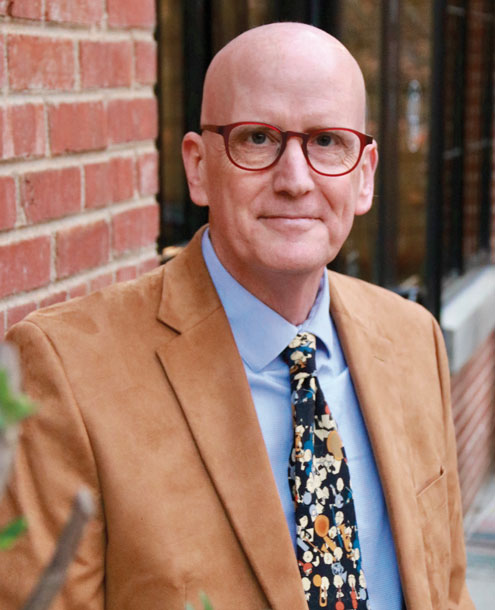
Adam Mohr
What does it take for students to transition from being dependent on their teacher’s guidance to having more intellectual independence?
I think a lot of it is teachable. It’s like learning a bag of tricks, such as, “When I’m confronted with a problem and I have no idea how to address it, here are some things I can try.” Those strategies are highly teachable, and they’re not things students get a ton of practice in. When we think about being self-directed, part of it is confidence—this feeling of, “This is something I’ve done before, and I’ve shown myself that I can be resourceful. I can get it done and figure out what to do.” But I think a lot of it is also learning concrete strategies that tell you how to cope with these situations.
You’ve written about how students tend to gravitate toward study practices that make them feel like they’re mastering the material, but might not actually lead to deep understanding. How can educators help students overcome this tendency?
The analogy I used in one of my books is that it’s like doing push-ups on your knees. If someone told you, “We’re going to have a push-up contest, so you need to train and be able to do a lot of push-ups,” and you come back in a month and say to them, “Things are going great; let me show you!” But you start doing push-ups on your knees, so they’d say, “What are you doing?” You might explain that you tried doing push-ups the way you were told, but they were very hard and you couldn’t do them. But you can do lots of push-ups on your knees!
That’s essentially what students do when they’re trying to study. They do things where their performance is really good, like doing lots of push-ups really fast. It feels good, because it isn’t hard. But to learn effectively, you need to do things that are difficult, and feel difficult. The fact that it feels hard doesn’t mean that you’re learning, but if you’re learning, it’s probably going to feel hard.
Serious cognition is hard. Learning is hard. Thinking is hard. People will avoid it if they feel like it won’t cost them too much to avoid it.
Ad Left
But there is this unfortunate characteristic: Your brain can frequently mislead you. For example, when you’re trying to commit things to memory, the environment can support your performance, which makes you think that everything you’re doing is based on memory. The most obvious instance of this characteristic is the common study strategy students use, when they read over their notes. If they have the lecture slides, they review the slides. This review makes the content feel very familiar.
If someone relistens to this podcast, they won’t think, “This is fantastic! What a great opportunity for me to hear all this content again.” Instead, they’ll think, “Oh, I’ve heard this before.” The fact that they’re recognizing it makes them feel like they know it. Similarly, when they read over content while studying, it’s very familiar. So they’ll say to themselves, “Yes, of course, this makes sense. I’ve got this.”
But the truth is that if they couldn’t see their notes, they probably wouldn’t be able to produce the content. Recognizing is not the same as being able to produce. We can misinterpret how much we’re getting out of something, and unsurprisingly, we usually overestimate how much we’re learning.
How can teachers help students feel more comfortable with the harder work of gaining deeper understanding and approaching assignments with greater independence, particularly when facing ambiguous or open-ended tasks?
Students feel uncomfortable because they’re very used to excelling, and they want to be sure that they will excel on this assignment. Open-ended assignments mean that I, as the instructor, can’t tell you exactly what the answer is going to look like. I recently finished teaching a senior seminar on high-level cognition. In their final paper, students had to have an interesting idea. I’m grading the papers based mostly on whether the idea is any good.
Understandably, some of my students got kind of irate. They’d say, “Look, just tell me what to do, and I’ll do it. How high do you want me to jump?” But when you get out of school, not everyone is going to tell you what to do. It’s going to be up to you to come up with an interesting idea. It’s not like baking a pie. I can’t tell you exactly what the recipe is.
So how can we make students feel more comfortable with that process? For starters, we can give them more assignments like that. Especially initially, we can make the assignment lower stakes, so that when students are feeling a bit lost, because they’ve never done this thing before, they can feel like, “Well, it’s not contributing that much to my grade. It doesn’t matter that much.”
The other consideration, with open-ended assignments, is that we can give students tools to help them know how to do it. If you want to give more assignments that encourage students to be independent, and they have very little experience doing that, then you need to teach them—in my case, what makes a question interesting.
If I say, “I’m going to grade you based on how interesting your question is,” I’ll set some criteria for that. The least I can do is tell my students, “Here’s what the rubric is. Here’s how I judge whether a question is interesting.”
Is curiosity something that we can develop within ourselves?
Curiosity is a way, clearly, to prompt you to learn about your environment. But you’re not interested in just gathering facts about your environment. You’re not curious about how many bricks are in that building over there. That’s a fact about your environment, but you’re probably not curious about it. We’re interested in learning new things that make us feel like we understand our environment, because understanding really means being able to predict. That’s a sensible hypothesis about the function of curiosity: If we can predict our environment, then we are better able to control it. We can anticipate what’s going to happen, which will obviously have some survival function for us.
Controlling that feels impossible. But you can try to get meta with it and say, “This is the kind of person I want to be.” For example, say someone invites you to a recital of a type of dance you’ve never experienced before. Candidly, I’m the kind of person who would say, “Eh, I don’t know anything about that. I’m probably not going to get it. No thanks.” But I could tell myself, “Dan, this is the person you want to be.”
The other thing you can do is try to place yourself in information-rich environments. Difficulty is an important variable here. If I know a lot about something, I already understand it. If I know absolutely nothing about something, I don’t know what’s going on and I won’t be curious to learn more. Finding an intermediate level is very useful.
You can try to put yourself in situations where that intermediate kind of information is hitting you more often. You could find websites that are a little meatier, or when you find a particular author you love, see if you can find other content by that author. Those are some strategies in everyday life for trying to feel more curious about things you want to be curious about.
What’s the difference between classroom learning and the more independent, real-world learning we need outside of school?
Outside of school, you need to decide what you’re going to learn. What is demanded of you cognitively, outside of school, is also quite different from what happens inside of school. Outside of school, no one checks up on your work, whereas in school, you know they will. One thing about cognition is that we’re pretty susceptible to hunches. We have intuitions about things. If you stop and think for a moment to check up on that intuition, you may recognize that it wasn’t correct. When you’re out in the wild world, no one is checking you, and you frequently don’t feel the need to check your work in the same way you would at school, where you might be a bit more motivated to do it.
“We’re pretty susceptible to hunches, and when you’re out in the wild world, no one is checking your work the same way they would at school.”
There are other differences as well. A common characteristic of real-world problems is that they’re probabilistic. There isn’t really an algorithm for that, and you understand that the answer isn’t “yes” or “no.” But people are not good at thinking about probabilities. Probability is something that humankind derived as a way of describing the world. It’s not a natural way to think. There are lots of ways we get probabilities wrong. One famous example is the gambler’s fallacy: If I’m tossing a coin, for example, and I get three heads in a row, it feels more likely that the next toss is going to be tails. That’s not true, of course—every flip is independent. But the gambler’s fallacy is that these independent events don’t have independent probabilities.
It’s really helpful to be good at thinking about probability when you get out into the real world and you have to do things like pick a health plan—you’re judging the probability that you or someone in your family will get sick in the next year.
What would you tell educators who want to foster a better classroom environment where they can encourage their students to push themselves to think independently and take academic risks?
First, I would suggest not doing that in an introductory class. Students may try to do it if you ask them to, but you’ll probably be a little disappointed. You will feel a little weird, because they’re going to say a lot of stuff that doesn’t make any sense. I would save the concept for when they at least have an intro course under their belts.
Then I would make it a very explicit assignment. Say something like, “Here’s a situation. Tell me the typical way of thinking about it, and then tell me an unusual way of thinking about it, or a way that raises questions.”
You need to give them some tools, because they’re not going to know the starting points. There are standard ways of trying to provoke creativity, such as thinking in opposites. For example, you can say that normally we would fully expect a particular value to get larger. But let’s think of a way, no matter how crackpot, that it gets smaller. Even if that exercise doesn’t end up being productive in itself, it’s going to free their minds a little bit. Maybe they’ll come up with an interesting idea.
What gives you the most hope about students’ capacity for independent critical thinking today?
I’Ve always been quite positive about what I see in college students. Of course, I recognize that I’m seeing a pretty select group. That said, these students are really good. They’re curious about stuff. They’re irreverent at the right times. They’ll call professors out on things they say that aren’t backed up. I haven’t seen a big change in that. These 18- to 22-year-olds are smart, resourceful, and interested in stuff. It’s very fun to have a job where you get to hang around with that age group and talk about interesting ideas.
American Scientist Comments and Discussion
To discuss our articles or comment on them, please share them and tag American Scientist on social media platforms. Here are links to our profiles on Twitter, Facebook, and LinkedIn.
If we re-share your post, we will moderate comments/discussion following our comments policy.