Transits, Travels and Tribulations, III
By J D Fernie
Two 1761 French expeditions to witness the transit of Venus
Two 1761 French expeditions to witness the transit of Venus

DOI: 10.1511/1998.21.123
Regular readers will recall that we are in the midst of a series of columns on the 18th-century transits of Venus. A transit of Venus is the occasion of that planet coming directly between the earth and the sun, so that we see it as a black blob moving slowly across the face of the sun. As explained in part I, the timing of this event leads eventually to a knowledge of the scale of the solar system, a quantity essential to astronomy but poorly known in the mid-18th century. It was also the case that although there would be transits of Venus in 1761 and 1769, there would be none thereafter for more than 100 years, so it was important to make the most of the opportunity. Thus strenuous efforts were planned by the major scientific bodies of that era to make the necessary observations. The difficulty, though, was twofold. First, adequate precision required that observers doing the timing be as widespread across the earth as possible, even though exploration of distant lands was still decidedly limited. Second, the major powers, particularly the two strongest naval powers, Britain and France, were at war with one another in 1761, making sea travel extremely hazardous.
In my second column on the topic, I described two of the British expeditions to observe the 1761 transit—that of Mason and Dixon to South Africa, and Winthrop's Harvard expedition to Newfoundland. In addition, we looked at the misfortunes of a French expedition, that of Pingré to the island of Rodrigues in the Indian Ocean. Here we deal with the two other French expeditions of 1761, that of Jean Chappe d'Auteroche to Siberia, and of Guillaume-Joseph-Hyacinthe-Jean-Baptiste Le Gentil de la Galaisière to India.
Chappe came from a family of the lower French nobility, but since he was only 31 when he was admitted to the Académie Royale des Sciences in 1759, and since the 1769 transit cost him his life, his career was short-lived and we know little about him. Certainly his early entrée to the Académie, and the work he did on his transit expeditions, bespeak a person of talent and determination. Who knows what he might have achieved in a longer life?
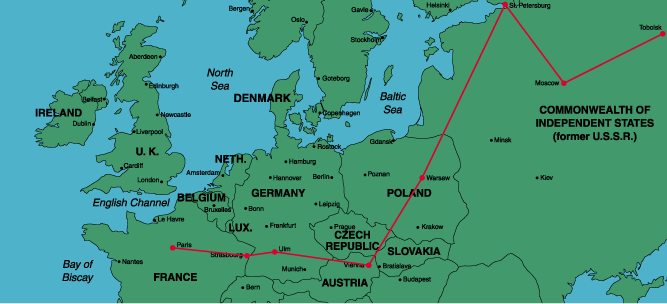
Through an invitation from the Russian Imperial Academy of Science, the Académie Royale des Sciences appointed Chappe to observe the transit of June 6, 1761 from Tobolsk, a city in central Siberia some 5,000 kilometers from Paris. This site was chosen because both the start and finish of the transit would be visible from it, granted clear weather. Protocol dictated that Chappe pay his respects to the Russian Academy in St. Petersburg en route, and since travel would be slow he would necessarily face a crossing of the Ural mountains and Siberian travel in a Russian winter.
Chappe initially hoped to reach St. Petersburg, the halfway mark of his journey, by ship, traveling around the coasts of northwestern Europe. He further hoped to avoid the wretched war between France and Britain by booking passage on a Dutch ship, but a delay in organizing "un appareil considérable d'Instruments" made him miss the sailing. He later dryly noted his consolation was that this probably saved his life when the ship ran aground on the coast of Sweden. Travel by land it would have to be, aiming for Strasbourg, Vienna, Warsaw, St. Petersburg, Moscow and then striking out across the Siberian plains and over the Urals for Tobolsk. Chappe's expedition left Paris in late November 1760.
Edward Roberts
It says something of the times that even within civilized France the journey to Strasbourg, a matter of hours in a car today, took eight days over highways so bad that every thermometer and barometer was broken, and the carriages were damaged beyond repair. What must Chappe have thought, considering that this was only the first small step of his journey and that conditions to come would be much worse? But again in tune with his times, he simply set himself to making a new set of instruments, while new carriages were arranged. He did, however, decide to head first for Ulm and then go by boat down the Danube to Vienna. He was strongly advised against this, since it was the season when heavy river fogs could delay boats for days, but he took to the river nevertheless.
Again one is struck by the "Renaissance Man"nature of these 18th-century scientific expeditionaries: No lounging around the boat for Chappe. He was busily mapping every turn of the river, since France lacked maps of the upper Danube. When fog on the river left the boat immobile, Chappe was off climbing the surrounding mountains, barometer in hand, to determine their altitudes.
Vienna was reached on the last day of 1760, and after a reception by Maria Theresa, Archduchess of Austria, and her husband, Francis, the Holy Roman Emperor, as well as meetings with local astronomers (comparing barometers, magnetic compasses and the like) Chappe left Vienna on January 8, 1761. It was a cold day, with temperatures around –23 degrees Celsius, and soon Chappe and his men were having to smash their way by foot through half-frozen river crossings. By January 22 they were in Warsaw, where Chappe heard he was awaited in St. Petersburg "with great impatience." Crossing the frozen Vistula, the expedition for the first time transferred to sleds, with Chappe reporting on "the ease of travelling with sledges; we went on with the greatest velocity…."
In St. Petersburg he learned that, in light of his delays, the Russian Academy had given up hope of his reaching Tobolsk in time and had sent out expeditions of their own (which seem never to have been heard from) to nearer sites. But Chappe was determined to reach Tobolsk before the transit. Thanks to the Empress, his expedition was equipped with every necessity, from bread to interpreters, and left St. Petersburg in early March on four enclosed sleds, each drawn by five horses running abreast. (One pictures a scene out of Doctor Zhivago or something from Tolstoy.) The sleds were smashed beyond repair by the time they reached Moscow, but on March 17 they left that city with new sleds, still with nearly 800 leagues (3,800 kilometers) to go, including crossing the Urals. Paradoxically, while they cursed the bitter cold they prayed for continued cold weather. A thaw would strand them in the Siberian bogs, from which they might never emerge. It took a month (Chappe furiously writing reports on everything he encountered), even though "the surface of the Volga was as smooth as glass … and the sledges went on with inconceivable swiftness." His retinue chose to desert him in the depths of a Siberian forest, and Chappe had to hunt them down, pistol in hand, but eventually the expedition found itself in Tobolsk in mid-April, well before the June transit.
Aided by a military party appointed by the local Governor, Chappe soon built a working observatory on a nearby mountain, and began observations to determine his longitude and latitude, essential for the eventual calculations of Venus's distance. However, Tobolsk lies at the confluence of the Irtysh and Tobol rivers, and the thaw that set in with his arrival was unusually rapid, with heavy flooding of the town. To some locals, this was no doubt due to the activities of the foreigner said to be messing with the sun, and mutterings of mob action to deal with him necessitated an increase in Chappe's military guard.
Chappe could sleep only fitfully the night before the transit, even though he reported that "the perfect stillness of the universe completed my satisfaction and added to the serenity of my mind." The day itself proved perfect, and Chappe observed the entire transit. At the start, he says, "I was seized with an universal shivering." But as the hours wore on and success became ever more imminent, "I truly enjoyed [the pleasure of] my observation, and was delighted with the hopes of its being still useful to posterity, when I had quitted this life." Indeed his observations were still prominent in calculating the scale of the solar system more than 100 years later.
Couriers bearing the essential observational data were quickly dispatched to Paris and St. Petersburg, but Chappe himself stayed on making further latitude and longitude observations, not to mention notes on everything that came his way. He eventually made a leisurely return trip through southern Russia, arriving back in Paris almost 18 months after the transit. The only sour note came later when Chappe published his no doubt honest yet excoriating views on Russian backwardness, despite the help he had received from Russians throughout his travels. No less a personage than Catherine II, writing under a pseudonym, undertook a line-by-line rebuttal. No matter. For the next transit Chappe was to abandon the winter wastelands of Russia for the deserts of Mexico.
The abbé Le Gentil was another who would pursue both transits. Indeed, his 11-year odyssey would rank as the longest astronomical expedition in history. Despite a contemporary saying of him that "his face did not prejudice one in his favor," at 28 Le Gentil was a well-trained astronomer. By 1753 he had made his own calculations of the transits and had volunteered to go to Pondichery in India to observe the June 6, 1761 event. He sailed from Brest in a French man-of-war in March 1760, allowing himself plenty of time to sail around southern Africa and across the Indian Ocean. Most of this trip was "uneventful, save for the loss of a fellow passenger by suicide and by the pursuit by an English fleet off the Cape of Good Hope." Arriving at Isle de France (Mauritius) in July 1760, however, he discovered that Pondichery was besieged by the British, and that a French force sent by sea to raise the siege had been all but destroyed by a hurricane while en route. A second force arrived after a delay of eight months, and Le Gentil accompanied it on its attempt to relieve the beleaguered Pondichery. Winds were contrary, however ("we wandered around for five weeks in the seas of Africa"), and by the time the fleet arrived off the Malabar Coast only two weeks before the transit, they discovered that the British had captured and consolidated themselves in Pondichery. Le Gentil's ship was lucky to elude the British naval squadrons and immediately headed back the 5,000 kilometers or so to Isle de France. In mid-ocean on June 6, under a cloudless sky, Le Gentil had a perfect view of Venus transiting across the sun's disk. But since precise timing of the event was essential, and his pendulum clocks useless at sea, the view was of no scientific value at all.
Rather than go home empty-handed, Le Gentil wrote to the Académie Royale des Sciences in Paris suggesting that he spend a year or so exploring the islands of the Indian Ocean, carrying out work in natural history, geography, navigation and more or less anything that might be useful. This was agreed to, and soon Le Gentil was busy mapping the east coast of Madagascar. Here he made the mistake of eating the local beef, which though "rich" caused "a sort of violent stroke, of which several copious blood-lettings made immediately on my arm and my foot, and emetic administered twelve hours afterwards, rid me quite quickly." The accompanying double-vision took somewhat longer.
Time went by. The war with Britain ended. The 1769 transit began to loom, and before long Le Gentil was suggesting that he stay on and try again for observations from this part of the world. His latest calculations suggested that going to Manila in the Philippines would be preferable to Pondichery (now back in French hands), and he even considered heading for the Marianas Islands in the Pacific until he learned that ships only went there every three years. Not waiting for agreement from Paris, he seized the chance of passage on a Spanish ship bound for Manila. It was not until July 1767, a year later, that a reply from the Académie Royale des Sciences caught up with him there. It announced that they would prefer to see him go to Pondichery after all. As it happened, Le Gentil was encountering considerable hostility from the corrupt governor of Manila (soon to be jailed himself), who apparently disliked all French citizens on principle. He claimed Le Gentil's papers must be false, and Le Gentil soon sensed that if he did not soon get away, he would probably find himself in a Spanish jail, if not worse. Clandestinely, he left on a ship bound for Madras in February 1768. It was a nightmare voyage, navigating through the islands and straits of the South China Sea, where the captain and his two pilots argued interminably over which passage to head for. Their arguments were so violent that at times all three would storm off to their cabins and leave the helmsman to his own devices. The captain, noted Le Gentil, "was as little in condition to conduct his vessel as I am to lead an army." On the other hand, the pilots were "two old automatons to whom I would not have entrusted the conduct of a launch." Nevertheless, Le Gentil finally found himself in Pondichery on March 27, 1768, more than a full year ahead of the transit.
Here he was warmly welcomed by the French Governor, Monsieur Law, and an observatory was established for him amid the ruins of a once-palatial estate. In the recent war it had served as a gunpowder magazine. In fact, Le Gentil's observatory was built atop a vault containing "sixty thousand weight of powder." Even so, "this circumstance did not interrupt the course of my observation," said Le Gentil, announcing his pleasure at living and working there. Even the British sent over an excellent telescope from Madras in case it was needed. Le Gentil settled into regular astronomical work, in particular the all-important determination of his precise longitude and latitude.
1768 gave way to 1769, and the transit date of June 3 approached. At Pondichery only the egress of Venus from the sun would be visible, but the precise timing of that event near 7:00 a.m. local time on Sunday, June 4 would be vital. "During the whole month of May, until the 3rd of June, the mornings were very beautiful." The evening before was clear and calm. But at 2:00 a.m. Le Gentil was awakened by "the moaning of the sandbar," implying a change in the wind. Leaping from his bed he "saw with the greatest astonishment that the sky was covered everywhere…. From that moment on I felt doomed, I threw myself on my bed without being able to close my eyes." A powerful wind brought even heavier cloud, "the sea was white with foam, and the air darkened by sand and dust…." Nothing in the sky was visible at 7:00 a.m., but around 9:00 a.m. the sun came out and "we did not cease to see it all the rest of the day."
Le Gentil's journal entry says it all: "That is the fate which often awaits astronomers. I had gone more than ten thousand leagues [50,000 kilometers]; it seemed that I had crossed such a great expanse of seas, exiling myself from my native land, only to be the spectator of a fatal cloud…. I was more than two weeks in singular dejection and almost did not have the courage to take up my pen to continue my journal...," especially when he later learned that near-perfect conditions had prevailed in Manila.
His one thought now was to return home, and he arranged passage on the first available French ship, due to leave Pondichery in October 1769. But he fell seriously ill with fever and dysentery, and missed the sailing. Indeed, he barely survived, but by March 1770, he was so desperate for home that, although still ill, he took ship for Isle de France as a first step. Here his convalescence continued for seven months, until in November he left on a ship bound for home via the Cape of Good Hope. Only two weeks out, though, an extremely violent storm almost sank them, and only great good luck brought them back to Isle de France on New Year's Day 1771. Another three months passed ("The sight of [Isle de France] had become unbearable to me"), but in March 1771, Le Gentil was aboard a Spanish warship, which finally returned him to Europe. On October 8, 1771, "at last I set foot on France at nine o'clock in the morning, after eleven years, six months, and thirteen days of absence."
He returned to discover that since no one in Paris had heard from him for so long, he had been presumed dead, and his seat in the Académie Royale des Sciences given to someone else, while his heirs were engaged in dividing up his estate. The latter problem took much expensive and tiresome litigation to correct, but intervention by the King gave him back a seat in the Académie within a few months.
There was a happy ending to his life. He lived another 21 years, married happily and had a daughter who became the delight of his life. He died of a relatively mild sickness at the age of 67 in 1792.
© J. Donald Fernie
Click "American Scientist" to access home page

American Scientist Comments and Discussion
To discuss our articles or comment on them, please share them and tag American Scientist on social media platforms. Here are links to our profiles on Twitter, Facebook, and LinkedIn.
If we re-share your post, we will moderate comments/discussion following our comments policy.