Science Book Gift Guide 2025
By
STEM-related books for any time of the year
December 8, 2025
Science Culture Communications Review Scientists Nightstand
It’s holiday time already (how did that happen so quickly?), and the editors of American Scientist have curated a compelling and diverse selection of STEM-related books for anyone on your shopping list, from young children to adults. This year saw many great STEM-related books be published, so rest assured, this is not an exhaustive list. If your holiday shopping is already finished, don’t worry—these books are perfect gifts any time of the year! (And you deserve a treat as well, right?)
For even more STEM-related book recommendations, don’t forget to check out some of our previous gift guides:
STEM Books for Young Readers
(Suggested age ranges, where noted, are those provided by the publisher.)
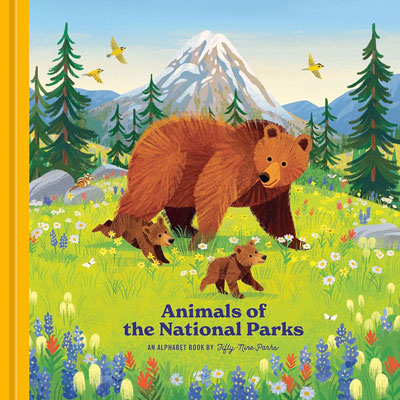
Animals of the National Parks: An Alphabet Book. Fifty-Nine Parks, illustrated by Kim Smith. Ages 3–5. Ten Speed Young Readers, 2025. $18.99.
I am a huge National Parks fan and love to read any book about the parks that I can find. This picture alphabet book features adorable illustrations, and for each letter of the alphabet, we read a little about a new animal, get a fun fact about them, and learn where in the parks the animal lives. For example, the letter D features: “Desert bighorn sheep climb high for a great view. They are excellent rock climbers. Desert bighorn sheep are found in Joshua Tree and Zion National Parks.” Other animals mentioned include jackrabbits, northern river otters, snowy egrets, and zigzag salamanders. It’s a fun book for any outdoorsy family—and in the back, there’s a map with all the national parks listed and a space to record notes, titled “National Park Memories.” –Jaime Herndon
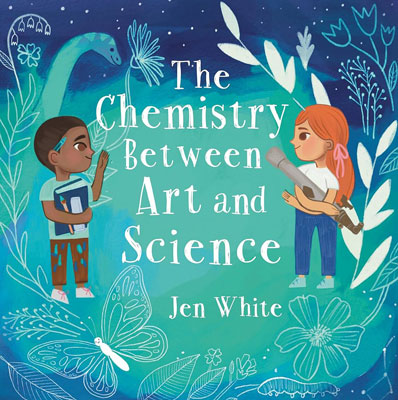
The Chemistry Between Art and Science. Jen White. Ages 4–8 years. Holiday House, 2025. $18.99.
When we think of a dynamic duo, we rarely think of art and science, but these two subjects have always been friends—some might even say colleagues. The Chemistry Between Art and Science by Jen White perfectly illustrates how these fields have always worked in tandem to bring us education, entertainment, and more. The brief synopsis of jobs in both art and science creates space for curiosity. Readers and listeners are reminded of how ballet dancers use geometry to convey emotion and tell stories. My favorite part of the book had to be the collaboration between origami artists and aerospace engineers, who help each other fold giant telescopes into space rockets. The origami activity at the end makes this a perfect book for your favorite schoolteacher, little one, or STEAM fan. –Nwabata Nnani
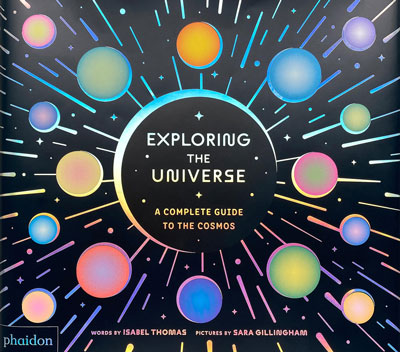
Exploring the Universe: A Complete Guide to the Cosmos. Isabel Thomas, illustrated by Sara Gillingham. Ages 8–12. Phaidon, 2025. $24.95.
Don’t let the age range fool you—though this book is marketed toward and written for kids, the material in here isn’t watered down. Thomas has written an accessible book about astrophysics and the galaxy. Paired with Gillingham’s vibrant illustrations and infographics, the book is an absolute pleasure to read. It’s set up as a set of entries, with each entry covering one topic, complete with key information, scientific category, history, diagrams, and more. At the bottom of many entries there are what the author calls “wormholes,” or related topics with a corresponding page number, that the reader can then explore if a certain topic captures their attention. The back of the book contains a glossary and a section with recommended books, websites, and apps to help the reader keep exploring the cosmos. Covering the history of astronomy and space science, near-Earth space, galaxies, stars, the Solar System, astronomical data, and much more, this book makes a great gift for the space nerd in your life, no matter how old they are. –Jaime Herndon
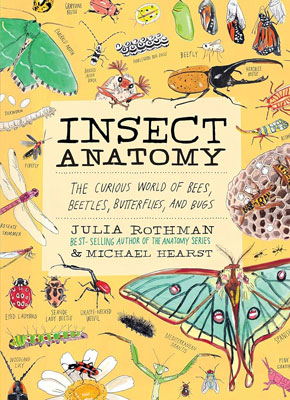
Insect Anatomy: The Curious World of Bees, Beetles, Butterflies, and Bugs. Julia Rothman and Michael Hearst. Storey Books, 2025. $19.99.
Rothman is the author of a number of other books in this Anatomy series, which includes topics as broad as nature, food, farms, the ocean, and wildlife. In this volume, she is relatively focused on covering insects, spiders, and anything that could be classified as a “bug.” She discusses the difference between insects and the others, as well as anatomy (eyes, antennae, and wings, for example). Other chapters cover lifecycles and metamorphoses, species that live in groups, notable features (such as camouflage and defense mechanisms), communication techniques, and all of the ways—both good and bad—that these creatures interact with humans. She also focuses on facts that appeal to kids, such as which insects or bugs are the weirdest, most colorful, or loudest. Extensive illustrations throughout make this a charming read. –Fenella Saunders
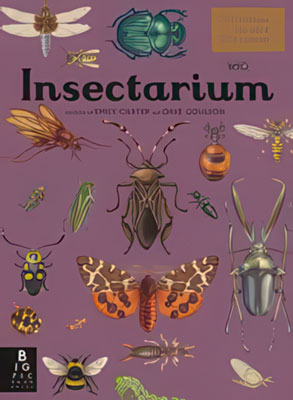
Insectarium. Dave Goulston, illustrated by Emily Carter. Ages 8–12. Big Picture Press, 2025. $37.99.
I have been a fan of the “Welcome to the Museum” series since the first book, Animalium, came out in 2014. These large-format, heavily illustrated books have been engaging even for younger children below the book’s reading level, because the images are so entrancing. These books are not encyclopedias, but rather are framed as virtual museums that provide a broad sweep of the topic with some deeper dives, organized into sections termed “galleries.” The latest volume in the series, Insectarium, gives good space to the more charismatic bugs, such as ladybugs and lacewings, but it also makes pest insects, such as ticks and lice, look fascinating and almost beautiful in their own right. The galleries include ancient insects (such as dragonflies), true bugs, true flies, lacewings, beetles, moths and butterflies, and wasps, ants, and bees. The book explains what defines an insect (as well as true bugs and true flies), and it also has a section on insect evolution. Each gallery includes a closing page about habitat, presented as a microcosm in a glass jar. The book ends with the importance of insects and why they need conserving. This series also includes separate activity books as companions to the main books, which are just as engaging. –Fenella Saunders
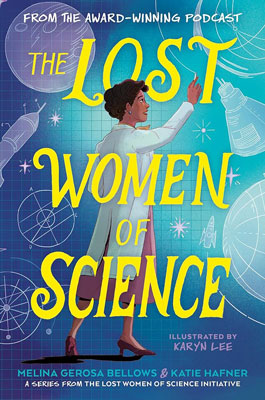
The Lost Women of Science. Melina Gerosa Bellows and Katie Hafner, illustrated by Karyn Lee. Ages 8–12. Bright Matter Books, 2025. $17.99.
Katie Hafner is the founder, host, and executive producer of the Lost Women of Science podcast, and she’s teamed up with Melina Gerosa Bellows to create a fascinating middle-grade book all about women in science that you probably haven’t learned about. The book introduces readers to 10 women in STEM whose work changed the world, including mycologist Flora Patterson, astronomer and astrophysicist Cecilia Payne-Gaposchkin, and phycologist and ethnobotanist Isabella Abbott. There are simple experiments having to do with each field of study described in the book for readers to do, and a bibliography in the back of the book provides plenty of resources for further reading. With fun sketches, rare pictures, and an engaging graphic layout, this is a book you’ll want to gift every tween, teen, and parent this holiday season. –Jaime Herndon
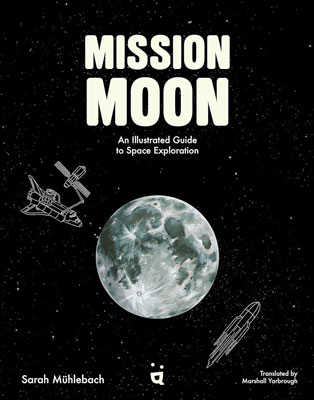
Mission Moon: An Illustrated Guide to Space Exploration. Sarah Mühlebach, translated by Marshall Yarbrough. Ages 8–11. Helvetiq, 2025. $22.95.
It would be a mistake if you brushed this aside because you thought it was “merely” a children’s book. This publisher put out the book Big Bangs and Black Holes: A Graphic Guide to the Universe, which is also fantastic and makes a great companion to this book. Though marketed to children, this is a fascinating, information-packed book about space exploration that not only covers the history of the Space Race and the people involved, but also looks toward the future and the issues we face, such as for-profit space exploration. The book discusses satellites in space, labs in space, spacewalks, and much more, all with fantastic and detailed illustrations with accompanying text about people, history, science, and technical details. It’s a fun introduction for kids, but also an engaging and informative book for teens and adults. –Jaime Herndon
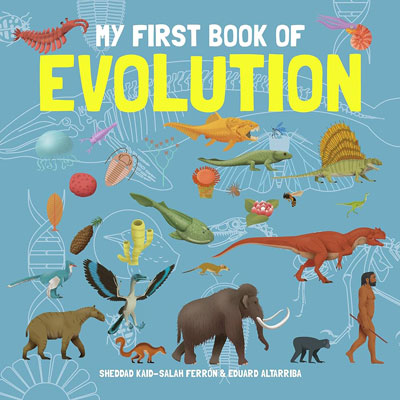
My First Book of Evolution. Sheddad Kaid-Salah Ferrón and Eduard Altarriba. Ages 8+. Button Books, 2025. $19.99.
The “My First Book” series covers topics that range from microbes to quantum mechanics, and the latest volume, My First Book of Evolution, follows the established pattern of beautiful illustrations, extensive graphics, and short bits of text interspersed throughout. These books have a different subject on each spread of pages, so kids can skip around or read from start to finish. The spreads cover topics that start with a definition of species, the work of Charles Darwin, natural selection, heredity, adaptation, mutation, genetic variability, coevolution, extinction, and even the possibility of extraterrestrial life. It’s an engaging volume for kids who want to know more about life and where it comes from, as well as where it could be going in the future. –Fenella Saunders
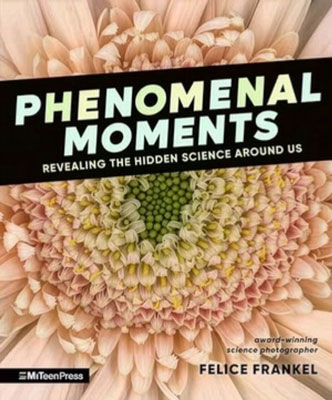
Phenomenal Moments: Images Revealing the Hidden Science All Around Us. Felice Frankel. Ages 13–17. MIT Teen Press, 2025. $21.99.
When I was a kid, I loved those “can you guess this image” games, which would show you an extreme close-up of an object and challenge you to identify it. Felice Frankel, a researcher and science photographer at the Massachusetts Institute of Technology, channels the playful energy of those old games and turns them into something both more personal and more scientific. She presents her full-color photos of a variety of superficially familiar items—a fence post, a water drop, a strawberry—and challenges the reader to look at them more closely and find the hidden physical processes written into them.
Each photo in the book is paired with two short blocks of text. One describes the moment when Frankel was inspired to take the shot, and why. The other decodes a phenomenon that gives the photo deeper meaning. Squiggles on the bottom of a swimming pool turn into a lesson about caustics, patterns created when light bends through the messy optical surface created by rippling water. The foam in a coffee cup inspires a confession that scientists cannot definitively explain how bubbles migrate to the edge of a mug: Even the most ordinary sights are full of wonder and mystery. Although it is nominally written for teens, Phenomenal Moments validates the cliché that it is for kids of all ages. –Corey S. Powell
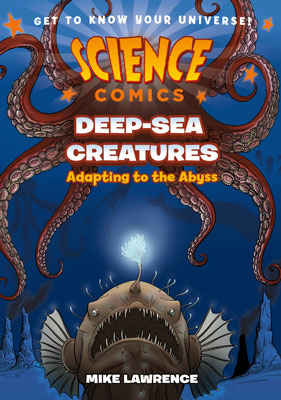
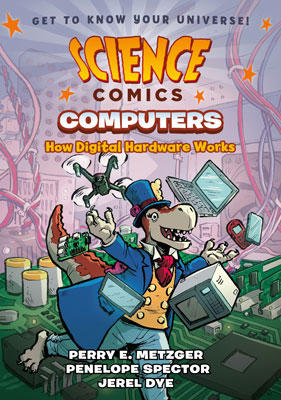
Science Comics: Deep-Sea Creatures: Adapting to the Abyss. Mike Lawrence; Science Comics: Computers: How Digital Hardware Works. Perry E. Metzger, Penelope Spector, and Jerel Dye. Ages 9–13. First Second Books, 2025. $13.99.
The extensive Science Comics graphic novel series offers two new volumes this year, to our continued delight. The series has a trend of putting whatever topic is covered into a somewhat madcap story line involving eccentric characters that help to deliver the facts while keeping the narrative moving along. These two new volumes, Deep-Sea Creatures and Computers, follow this recipe with very different ingredients, but both bake up really well. In Deep-Sea Creatures, our main storytellers are a monster-movie-obsessed seahorse and his son, guided by a fly-by-night tour company crewed by a sarcastic fringehead (yes, that is an actual species of fish). The seahorses learn about creatures at different depths, including viperfish, giant isopods, and yeti crabs. In Computers, our guide is a Victorian-era scientist who also happens to be a Tyrannosaurus rex—and who also sometimes eats the machines. With a tour through some of the early history of computing, the good professor explains the basics of programming, binary numbers, logic gates, and more complicated circuits. Both graphic novels are fun romps that kids can follow and maybe not even realize how much they’re learning as the plot unfolds. –Fenella Saunders
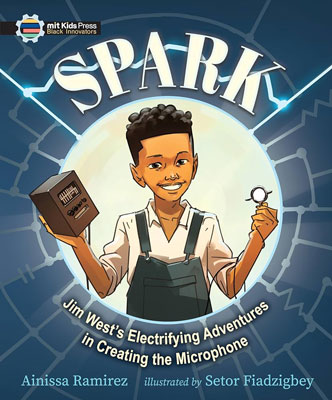
Spark: Jim West's Electrifying Adventures in Creating the Microphone. Ainissa Ramirez; illustrated by Setor Fiadzigbey. Ages 5–9. Candlewick, 2025. $18.99.
Part of the Black Innovators book series, this volume by Ainissa Ramirez showcases her skill as a storyteller. Ramirez focuses here on Jim West, who co-patented what’s called the foil-electret microphone, which became integral to devices from cell phones to hearing aids. A child who obsessively disassembled anything he could get his hands on and even accidentally electrocuted himself in the process, West was a natural scientist, but he grew up at a time when he likely would not have been hired even if he was able to get a degree. Undeterred, he put himself through college by fixing televisions and landed a summer internship at Bell Labs, where he was given a project of troubleshooting headphones that were too quiet. By tinkering, West discovered the material in the headphones would hold a charge without constant electricity, and he worked with other scientists to figure out how to use this material in a tiny microphone as well. He had a long career at Bell Labs and was awarded the National Medal of Technology and Innovation in 2006. Ramirez excels at turning these personal histories into seamless narratives, and the result is a story that should inspire anyone, especially kids who like to tinker. –Fenella Saunders
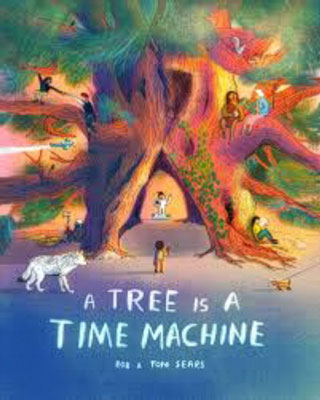
A Tree is a Time Machine. Rob and Tom Sears. Ages 9–11. Laurence King Publishing, 2025. $24.99.
“What’s the big hurry?” That’s the question Eunice, the yew tree, asks us humans. Rooted in patience and history, A Tree is a Time Machine by Rob and Tom Sears is a thoughtful reflection on a tree’s observation of the relationship between humans and time, as well as the overlap with nature, the sun, and seasons. Playfully using attributes of a tree, Eunice’s branches give a brief history of a few creatures that have roamed the Earth long before trees and humans—a friendly reminder of just how finite human existence is compared to, say, that of a giraffe, which has roamed planet Earth for one million years and counting. As Eunice calls into question the need for busyness, they also remind us to take a beat, breathe deeply, and think long term—as hard as that may be—and consider how our actions today impact someone else’s tomorrow. As Eunice would say, “You’re all connected by what you pass on.” So while we look to the future and our endless to-do lists, don’t forget to also remember the wonder of the past along with the trees, as nothing can change without the passing of time. –Nwabata Nnani
STEM Books for Adults
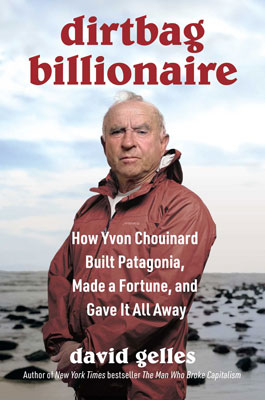
Dirtbag Billionaire: How Yvon Chouinard Built Patagonia, Made a Fortune, and Gave It All Away. David Gelles. Simon & Schuster, 2025. $30.
If you’re familiar with the outdoors brand Patagonia, you know that the company has always tried to prioritize giving back to the community, being socially responsible, and support environmental causes and conservation. But the company’s founder, Yvon Chouinard, took it a step even further: He essentially gave the company away by transferring ownership to a trust and a nonprofit organization, which meant slashing his wealth and giving all subsequent profits to helping fight the climate crisis. The company has not been without controversy and conflict, but what Chouinard did was nearly unheard-of. Gelles tells the story of how Patagonia was founded and developed, and how the brand set itself apart from its competitors with its consistent environmental activism and commitment to helping to make the Earth a better place to live. –Jaime Herndon

Girls Play Dead: Acts of Self-Preservation. Jen Percy. Doubleday, 2025. $29.
This book is a much-needed exploration of the ways in which women survive trauma and carry it with them (physically and psychologically), along with how fear shapes behavior. Percy then centers this in the context of the larger topic of sexual violence. She combines memoir with reportage and research, looking at evolutionary behaviors, societal scripts surrounding gender, the language used around trauma, and much more. While my personal interest lies in epigenetics and trauma—and I would have liked to have seen more on that in the text—this is an important book addressing issues that haven’t been discussed much. The fact that it’s not a textbook or overly academic is really important so that these topics can be brought to the general public and are more accessible to those who need the information. –Jaime Herndon
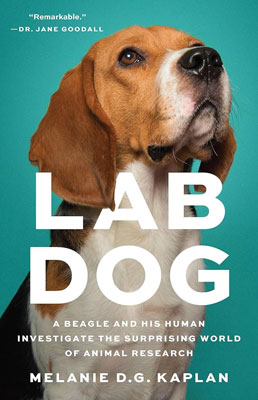
Lab Dog: A Beagle and His Human Investigate the Surprising World of Animal Research. Melanie D. G. Kaplan. Seal Press, 2025. $32.
Lab Dog is a deeply moving book by independent journalist Melanie D. G. Kaplan. Motivated by her curiosity about the origins of Hammy, the shy former research-lab beagle that she adopted, Kaplan delves into the world of animal research. How did Hammy get to where he was? Why are we still testing on animals, and is there an equivalent alternative? In this extensively reported book that blends research and reportage with narrative nonfiction and memoir, we learn about the disturbing history and continuing practice of using animals in laboratory research, as well as the touching bond that Kaplan and Hammy the beagle form along the way. –Barbara Aulicino
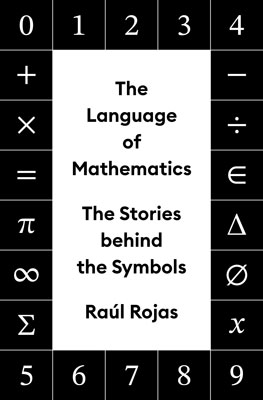
The Language of Mathematics: The Stories behind the Symbols. Raul Rojas, translated by Eduardo Aparicio. Princeton University Press, 2025. $27.95.
Life is full of things we take for granted, and math symbols are no exception. Fashioned and fought for across centuries, each sign encompasses a saga: When he wasn’t inventing the < and > symbols, Thomas Harriot was adventuring with Sir Water Raleigh and being thrown in prison for his association with the Earl of Northumberland; the obelus (÷) poetically ties together Helen of Troy, the Library of Alexandria, and English Civil War spy craft; the fractious fight between the Newton and Leibnitz factions included a two-century battle over calculus symbols.
The Language of Mathematics: The Stories behind the Symbols shines when describing these birth pangs. True, the math-phobic (or simply reckoning-rusty) might balk at its sporadic forays into the more rarefied air of Fermat’s theorem and Euler’s identity, especially because the book, which lacks a much-looked-for glossary, occasionally omits needed logical steps. But it would be a shame if such brief excursions prevented anyone from reading this largely accessible work. After all, math—as the title reminds us—is a language, and like all languages, limits or multiplies what we can conceptualize and communicate. This is a book for those who want to place as few bounds as possible on those prized capacities, and for those who long to recognize the beauty and the battles behind the most mundane notations. –Nicholas Gerbis
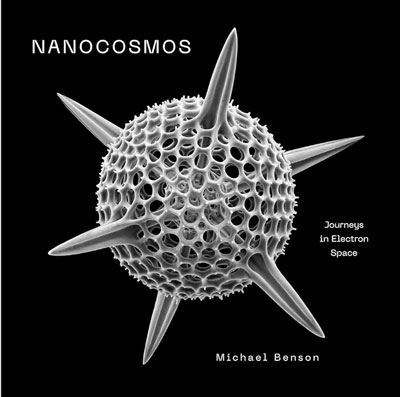
Nanocosmos: Journeys in Electron Space. Michael Benson. Abrams, 2025. $65.
Much of the pleasure of a great story comes from the element of surprise, and Michael Benson’s lavish new photo book packs several killer twists. Most obviously, he has cast aside his normal cameras and replaced them with a scanning electron microscope. But what really makes this book grab your attention is what he does with the technology. Benson has a remarkable eye for texture, whether it is capturing the bumpy compound eye of an acorn weevil or the extravagant geometry of the crystal skeleton on a radiolarian, a ubiquitous type of ocean zooplankton. Even when he is showing something familiar, such as an entire European honeybee, Benson finds unexpected topological beauty, rejecting the grotesque harshness often highlighted in science-book electron micrographs. The biggest shock in Nanocosmos arrives up front, in its opening section of Moon micrographs. These eerie images resemble landscapes, but they are actually extreme close-ups of lunar rocks collected during the Apollo missions, many of which are just a fraction of a millimeter wide. These scenes are otherworldly in scale and structure as well as in origin, and they are utterly gorgeous. –Corey S. Powell
The Story of Astrophysics in Five Revolutions. Ersilia Vaudo, translated by Vanessa Di Stefano. W. W. Norton & Co., 2025. $23.99.
Succinctly summarizing major scientific leaps forward is a true highwire act. Authors need to choose words that are clear without being grossly inaccurate and must digest volumes of dense text without skipping the stories and context that make discoveries clear and compelling—and that’s before tackling subjects as abstruse and nuanced as the Big Bang or special and general relativity. Given Ersilia Vaudo’s triumph in striking this balance, The Story of Astrophysics in Five Revolutions can be forgiven the rare stumble in word choice (including interchanging “rotation” and revolution,” a mortal astrophysical sin that perhaps stems from a mistranslation) or its occasional foray into theism-tinged poetry (“that cold, structured precision immediately seemed intentional”). We can pardon these minor infractions because Vaudo finds space in just 200 trade-paperback pages to both stir and surprise the reader (the antimatter chapter, which also delves into the oddly reciprocal relationship between mathematics and physics, is a model case). The author also squeezes in essential stepping-stone discoveries that many pop-science books omit (such as Minkowski spacetime) and makes amply clear which astrophysicists stood on which giants’ shoulders. Along the way, Vaudo also seeds each chapter with key ideas that were expanded, revised, or toppled by subsequent revolutions. Vaudo does this while also making room for people who were often eclipsed by rivals (as Hooke was by Newton) and while shining a light on hidden figures (such as French mathematician and physicist Émilie du Châtelet). In short, those with a passing familiarity with astrophysics will likely find something in these pages to inspire them, and even seasoned spectroscopists are liable to find verbiage that helps them convey to friends, family, and students just what exactly it is they do for a living. –Nicholas Gerbis
To the Moon and Back. Eliana Ramage. Avid Reader Press, 2025. $30.
If you read (and loved) Taylor Jenkins Reid’s Atmosphere: A Love Story—which is an amazing book in its own right—then I’d wager you’ll also love To the Moon and Back. Even though it’s a dense novel with various storylines and themes, I read it in two sittings because the immersive writing pulled me in each time. Rather than feeling disjointed, as some novels with different storylines and narrators can, each thread informs the others, and braided together, only strengthens the story. Set over three decades, the book follows Steph Harper, who’s dreamed of being the first Cherokee astronaut since she was a little girl. Ramage combines history and science arcs with a family saga composed of complex characters that provide plenty of conflict. Steph’s journey to pursue her dream is woven alongside those of her sister, an artist and an Indigenous social activist influencer whose work threatens to derail Steph’s career; her college girlfriend Della, with whom she has a complicated relationship; and her mother, who’s been holding secrets of her own, to create a STEM novel that you won’t soon forget. –Jaime Herndon
Women Travel Solo: 30 Inspiring Stories of Adventure, Curiosity, and the Power of Self-Discovery. Lonely Planet, 2025. $24.99.
You might be wondering what a travel book is doing in a STEM-themed gift guide—but sometimes the two are not so far removed from one another. Travel is a great way to study the natural world; indeed, it’s necessary to travel sometimes to do field work and observations. But beyond that, travel is also a great way to remember why it’s so important to support organizations that help protect and advocate for public lands, conservation, the environment, historic sites, endangered animals, and much more. Exploring Antarctica, observing the northern lights, visiting eco-farms in India—science is not a discipline that can be siloed off from everything else. And though this book is about travel, it’s a reminder of how deeply science is woven through our daily lives. –Jaime Herndon
American Scientist Comments and Discussion
To discuss our articles or comment on them, please share them and tag American Scientist on social media platforms. Here are links to our profiles on Twitter, Facebook, and LinkedIn.
If we re-share your post, we will moderate comments/discussion following our comments policy.