This Article From Issue
March-April 2026
Volume 114, Number 2
Page 66
Ad Left
If you know anything about the giant, exquisite space telescopes that already exist, you may think there’s nothing that they can’t do at this point. But talk to an astrophysicist and you will soon understand how much of outer space is still invisible to us, locked out beyond our ability to observe it.
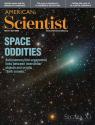
Darryl Seligman discusses the limitations of current data in “The Discovery of Dark Comets.” Seligman has been excited to observe the three known interstellar objects that formed elsewhere and traveled into our Solar System. The composition and activity of those objects can give astronomers new information about how small bodies are made in the universe, but they are in view for a frustratingly short period of time. Even within our Solar System, Seligman points out, the quest to learn more about elusive objects called dark comets is hampered because they just don’t have data that is detailed enough to see what’s really out there. Nonetheless, as Seligman describes in his article, the interstellar objects are inspiring astronomers to look for these comets that don’t behave in standard ways, and in the process, they are discovering information about what could be an entirely new class of small celestial bodies.
All the feature articles in this issue involve phenomena that are obscured from view. In “Mantle Waves,” Thomas Gernon and Sascha Brune take us deep into the Earth to explore a phenomenon that has a charismatic result—diamonds. The places where these gems rise up from deep underground are often quite far from tectonic boundaries. Gernon, Brune, and their colleagues have spent several decades investigating what processes are going on at the boundary between Earth’s crust and mantle, and how those interactions set up chain reactions of diamond eruptions progressively further inland. The underlying mechanism, called mantle waves, could explain not just diamonds but also other geologic features, such as the ranges of cliffs called the great escarpments that have formed on different continents.
We change directions and scales as we follow Peter Snyder into the microscopic layers of the human retina, in “Looking Through the Eye and into Alzheimer’s Disease.” The retina is the only part of the central nervous system that we can directly and noninvasively image, Snyder explains, and it can be seen as a model for what’s going on in the brain. Snyder and his colleagues have been investigating subtle changes in the retina that can appear in people with Alzheimer’s disease decades before individuals start to experience symptoms. A regular eye exam, he says, could end up being an early warning system for the disease, if experts can clearly establish the hallmarks.
All of these disparate areas of science show us things that we could not see on our own, and all need a lot more data to become fully established. That’s why strong support for scientific research is of benefit to everyone. And that’s why we’re asking you to continue submitting your letters about why your science is important. Please keep your letter submissions to no more than 300 words. Let us know whether you would like us to keep your letter anonymous, or if you are comfortable sharing your name, location, or both. Please note that as a nonprofit, American Scientist is not permitted to endorse any specific legislation or candidate, but we can support evidence-based science policy, so please keep your submissions nonpartisan. Focus your submission on why your work is important, effective, and worth carrying out. Send your submissions to editors@amscionline.org with the subject line “Science Is Important.” Submissions may be published in print or on our website, and may also be featured on social media.

American Scientist Comments and Discussion
To discuss our articles or comment on them, please share them and tag American Scientist on social media platforms. Here are links to our profiles on Twitter, Facebook, and LinkedIn.
If we re-share your post, we will moderate comments/discussion following our comments policy.