Garrett James Hardin (Dallas 1915 - Santa Barbara 2003)
By Vaclav Smil
Ecologist Garrett Hardin's vivid parables popularized "the tragedy of the commons"
Ecologist Garrett Hardin's vivid parables popularized "the tragedy of the commons"

DOI: 10.1511/2004.45.8
In the world fond of simple associations, Garrett Hardin will be remembered above all as the man who made millions familiar with a concept known as "the tragedy of the commons." He wrote an article with that title for Science in 1968, when the first wave of environmental consciousness was swelling. That short essay became one of the most famous (and among the most cited and reprinted) pieces of ecological or, as Hardin would have preferred, "bioethical" writing.
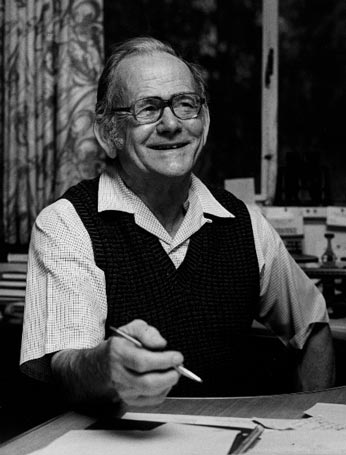
Courtesy of the University of California, Santa Barbara.
Contrary to the usual perception, this concept was not Hardin's invention. Such grand generalizations almost always have important precedents. Hence it is doubtful that even Aristotle, who pointed out long ago that "what is common to the greatest number has the least care bestowed upon it," was the first to reach this conclusion. Hardin does, however, deserve credit for recognizing the magnitude and the inevitability of this tragedy: It's not a deviancy or madness but rather perfectly rational behavior that leads to the long-term ruin of the commons, a word that evokes communal agricultural lands but also applies to ecosystems, rivers, oceans, organisms or mineral resources. That is, actions that benefit the individual (meaning single persons, households, villages, companies or nations) in the short term often end up hurting the collective.
Hardin's greatest service was presenting this notion in the form of a captivating parable about an overgrazed pasture and expressing it in precise, resonant language that left no room for appealing the initial verdict. He wrote: "Ruin is the destination toward which all men rush, each pursuing his own interest in a society that believes in the freedom of the commons." (Today's editors would, of course, have tried to force Hardin to change "men" to "people" or some other politically correct choice—probably to no avail.) He realized that this ruinous dynamic operates in any number of cases involving environmental pollution and the degradation of ecosystems. These instances include three of the leading concerns of our generation: extensive and drastic commercial overfishing of the oceans, continuing deforestation of the humid tropics and rising emissions of greenhouse gases, which may cause serious global warming during the latter half of this century.
Hardin was a man of many causes, yet several of his major writings were variations on the theme of the ruined commons. This is true about another of his widely read and reprinted essays, "Living on a Lifeboat," published in BioScience in 1974. There he used another parable to argue that immigration of the poor to affluent countries hurts those already living there, just as taking too many drowning people into a lifeboat risks sinking everybody. If the connection between these two essays wasn't apparent enough, it became so in 1995, when he published a book with the title The Immigration Dilemma: Avoiding the Tragedy of the Commons.
Clearly, Hardin was concerned about the number of people the United States could support. So it should not come as a complete surprise to learn that he was a founding member of Planned Parenthood and one of the nation's most influential advocates of population control and abortion on demand—the issue he said occupied most of his time between 1963 and 1973, the year that the Supreme Court made its landmark decision in Roe v. Wade. (It might come as a surprise, however, to learn that Hardin and his wife had four children.)
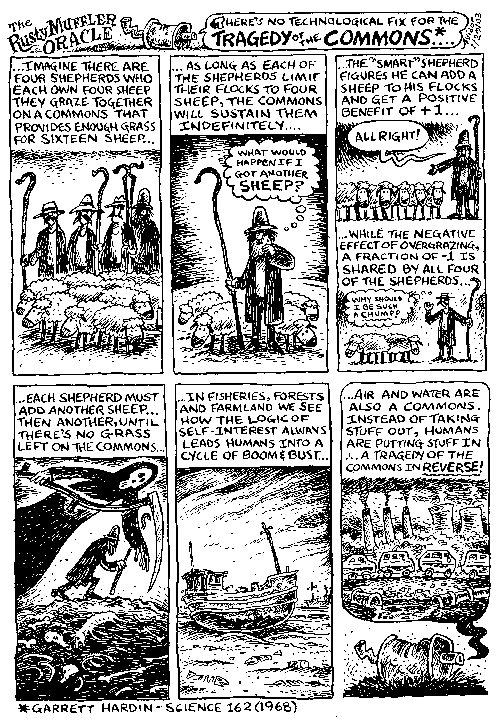
Ken Avidor
But Hardin was more than a policy advocate: He was also an intellectual pioneer. Both his earliest bioethical writings and his last books, written during the 1990s, are widely seen as important stepping-stones to the newly created field of "ecological economics." This discipline tries (perhaps quixotically) to reform the tradition of ignoring nature in economics, which normally shares with ecology little more than the descriptive Greek root in its name.
It is thus not an easy task to understand this man. For those who want to explore Hardin through just a single volume of his writings, I would recommend Living Within Limits: Ecology, Economics and Population Taboos, published in 1993. All of the great causes, targets and taboos that have been at the core of modern environmental and ecological debates and that Hardin defended, attacked and confronted during his long life are here: limits to growth, overpopulation, cowboy economics, demographic transition, nuclear energy, carrying capacity, human rights, globalization, Spaceship Earth, economic growth, altruism, birth control, energy consumption, immigration, and the irreconcilability of ecology and traditional economics. There are, not surprisingly, extended quotes from Aristotle, the Marquis de Condorcet, Thomas Malthus, Adam Smith, John Stuart Mill, Kenneth Boulding, Benjamin Franklin and Charles Darwin, but also, revealingly, Hardin includes bits from Galileo, Sir Arthur Eddington, William Stanley Jevons, Otto Frisch, Thomas Huxley and C. P. Snow.
The book is full of Hardin's terse, politically incorrect one-liners, which he often used as headlines of chapter sections—In Praise of Discrimination, Compassion Breeds Taboo, A Suicidal Right (meaning the right to have children)—and arguments that can almost instantly reverse a reader's feeling from approbation to shock. To argue for population control is one thing, but it's quite another to write that we need to reexamine the assumption that a low rate of infant mortality serves as a valid measure of the state of a civilization. How, after all, could any advanced society not do all it could to preserve the lives of newborns? And what would Hardin's alternative be, anyway? Would he have some state bureaucrat decide which birth defect is economical to fix and which one should spell an immediate death sentence?
Hardin was well aware of how difficult it was for most of his fellow citizens to approve of his drastic prescriptions. Still, he pushed his argument mercilessly, writing that "mortality—death—can be easily tallied, but morbidity—pain and suffering—is much harder to measure. Yet morbidity may be the more important measure of happiness." How much of this focus on anguish comes from the experience of a man whose physical life was constrained by the polio he contracted at the age of four, which weakened his right leg and made it 5 centimeters shorter than his left one. Decades later, polio's delayed effects weakened the muscles in his left leg enough that he was confined to a wheelchair, and the fear of losing strength in his arms led him to talk openly about looking for Dr. Kevorkian.
Even when I disagreed with him, I always admired Hardin's moral fervor—a quality in such short supply in modern, avowedly value-neutral science—and welcomed his infusion of ethics into science and public decision-making. And I particularly liked the way he did it: delivered with style, in an unapologetic, forthright, true agent provocateur fashion, but one built on firm beliefs and on wide-ranging scientific knowledge. He stressed true literacy (by which he meant the correct use of terms, and abhorrence of phrases that might even slightly resemble the currently rampant political correctness) and numeracy (a skill that is in even shorter supply). This is exactly what I preach to my students and emphasize in my writings. His anguish about the state of the global environment could be mine. And I could readily agree with a number of his arguments advanced in favor of birth control and legalized abortion, but I was never comfortable with Hardin's militant stance on these topics.
What is one to do, for example, upon reading in Hardin's open 1997 letter to the American Civil Liberties Union that "a medical abortion, particularly in the early stages, costs only a fraction as much as a medically supported childbirth—not to mention the costs of education and other social services to the child for 18 years. So: when a woman elects to have a child, she is committing the community to something like $100,000 in expenses for the bearing and rearing of that child. Is it wise to extend individual rights that far?" Here he tops even the draconian family planners of China. As a former demographer, I am not afraid, as Hardin was, that we will ever get to 50 billion people. (Most current forecasts put the likely maximum even below 10 billion.) And I see excessive consumption as a much greater threat to the integrity of the biosphere than a temporarily large, but eventually self-regulating, global population.
And being myself a lucky double immigrant (first from Europe to the United States, then from there to Canada), I could never go along with his harsh and categorical condemnation of moving from a poorer to a richer place. I emigrated from what was then the westernmost outpost of the Soviet empire for political and intellectual reasons, but that motivation would not have made any difference to Hardin's basic argument: Whereas ours may be a relatively frugal household, there is no doubt that since 1969 my family has certainly consumed more living on this continent (helping to sink the Hardinian lifeboat that much faster) than we would have by staying in the impoverished Communist paradise. But should we, and millions of others who made that journey before or after us, then see our coming to live in the New World as a fundamentally immoral act? And would Hardin's judgment be the same had he grew up in a Stalinist country or in the Haitian countryside?
Given my background, I'd probably be the last ecologist on Earth to defend Hardin's stance on immigration. Nor can I muster any enthusiasm for Hardin's two other great causes, legalized euthanasia and assisted suicide: I just cannot dismiss the many concerns these policies would inevitably raise—at least not as easily as he did, by saying that "every ethical decision puts you on the slippery slope." But I am always delighted to repeat Hardin's definition that "ecology is the overall science of which economics is a minor specialty." And I wholeheartedly endorse his longstanding conviction that ethics must guide us whenever we face difficult choices and must be built on scientific foundations.
Such a dichotomy of reactions to Hardin should not be surprising. As a radical thinker and, fundamentally, a combative moralizer fond of categorical pronouncements, Hardin did not make things easy for his readers. So it's possible to mix enthusiastic approval of some of his unconventional judgments with qualified acceptance of other conclusions and with outright rejection of some of his favorite views. Only one thing was impossible: to remain indifferent in the face of his impassioned arguments. Of course, Hardin also attracted many devoted admirers, whose virtual gathering place is the Web site of The Garrett Hardin Society (http://www.garretthardinsociety.org), which contains much about his life and work.
There, for example, one learns that Hardin had a rather settled academic career. He came to the University of California, Santa Barbara, in 1946 (his Stanford Ph.D. was granted in 1941), becoming a professor of human ecology. He stayed in Santa Barbara after his nominal retirement in 1978, remaining active in many ways (lecturing, writing, giving interviews) for another two decades. This geographic stability was quite atypical for that generation of America's peregrinating professors and was in a great contrast to his bold intellectual forays. But, true to himself, in death he was a resolute radical: He and his wife, Jane, belonged to the Hemlock Society, and on September 14, shortly after their 62nd wedding anniversary, they committed a double suicide at their Santa Barbara home. The great moralizer lived and acted as best as he could in accord with his favorite saying of the Buddha: "I teach only two things: the cause of human sorrow and the way to become free of it."
Click "American Scientist" to access home page
American Scientist Comments and Discussion
To discuss our articles or comment on them, please share them and tag American Scientist on social media platforms. Here are links to our profiles on Twitter, Facebook, and LinkedIn.
If we re-share your post, we will moderate comments/discussion following our comments policy.