
This Article From Issue
May-June 2026
Volume 114, Number 3
Page 136
Nuclear fusion is an attractive energy source because it is safer than fission, produces no carbon emissions and minimal radioactive waste, and relies on abundant fuels such as deuterium (an isotope of hydrogen). Physicists have been researching nuclear fusion for decades, but no reactor yet built is capable of true energy generation. Several start-ups are trying to produce fusion reactors that are as useful as traditional power plants. These efforts take three general technological approaches.
Gary Schroeder
Ad Right
Magnetic Confinement
CFS SPARC aims to shrink the conventional tokamak design.
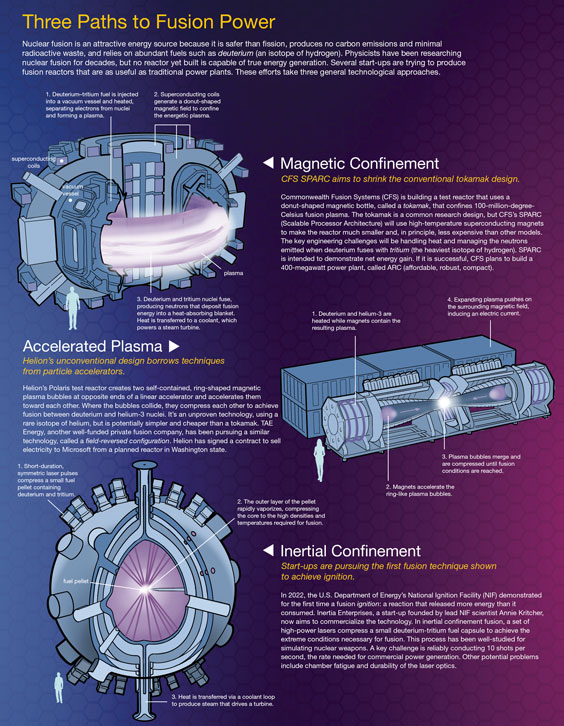
Commonwealth Fusion Systems (CFS) is building a test reactor that uses a donut-shaped magnetic bottle, called a tokamak, that confines 100-million-degree-Celsius fusion plasma. The tokamak is a common research design, but CFS’s SPARC (Scalable Processor Architecture) will use high-temperature superconducting magnets to make the reactor much smaller and, in principle, less expensive than other models. The key engineering challenges will be handling heat and managing the neutrons emitted when deuterium fuses with tritium (the heaviest isotope of hydrogen). SPARC is intended to demonstrate net energy gain. If it is successful, CFS plans to build a 400-megawatt power plant, called ARC (affordable, robust, compact).
Accelerated Plasma
Helion’s unconventional design borrows techniques from particle accelerators.
Helion’s Polaris test reactor creates two self-contained, ring-shaped magnetic plasma bubbles at opposite ends of a linear accelerator and accelerates them toward each other. Where the bubbles collide, they compress each other to achieve fusion between deuterium and helium-3 nuclei. It’s an unproven technology, using a rare isotope of helium, but is potentially simpler and cheaper than a tokamak. TAE Energy, another well-funded private fusion company, has been pursuing a similar technology, called a field-reversed configuration. Helion has signed a contract to sell electricity to Microsoft from a planned reactor in Washington state.
Inertial Confinement
Start-ups are pursuing the first fusion technique shown to achieve ignition.
In 2022, the U.S. Department of Energy’s National Ignition Facility (NIF) demonstrated for the first time a fusion ignition: a reaction that released more energy than it consumed. Inertia Enterprises, a start-up founded by lead NIF scientist Annie Kritcher, now aims to commercialize the technology. In inertial confinement fusion, a set of high-power lasers compress a small deuterium-tritium fuel capsule to achieve the extreme conditions necessary for fusion. This process has been well-studied for simulating nuclear weapons. A key challenge is reliably conducting 10 shots per second, the rate needed for commercial power generation. Other potential problems include chamber fatigue and durability of the laser optics.

American Scientist Comments and Discussion
To discuss our articles or comment on them, please share them and tag American Scientist on social media platforms. Here are links to our profiles on Twitter, Facebook, and LinkedIn.
If we re-share your post, we will moderate comments/discussion following our comments policy.