The Power of Nexus Planning
By Luxon Nhamo, Sylvester Mpandeli, Tafadzwanashe Mabhaudhi
Achieving sustainability entails weighing trade-offs and collaborating among interconnected sectors.
Achieving sustainability entails weighing trade-offs and collaborating among interconnected sectors.

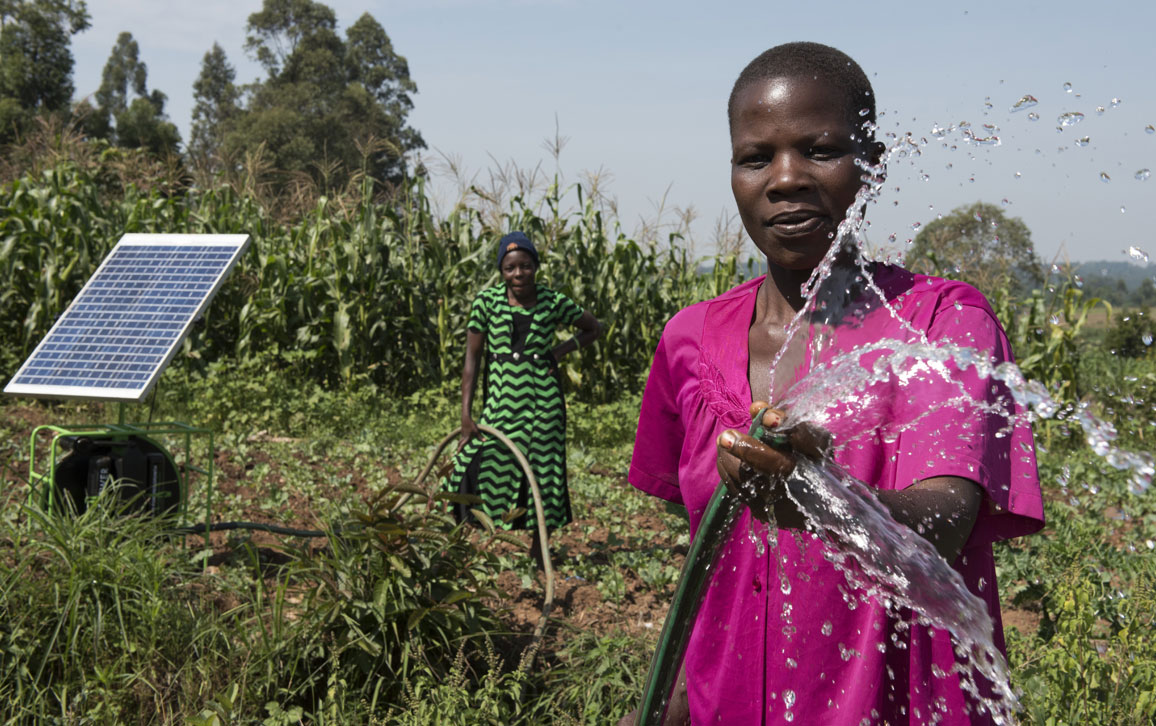
Water, energy, and food are intricately interlinked, as is evident in many developing countries that plan to increase their irrigated area to ensure that their agricultural production meets the food requirements of a growing population under climate change. Global food production needs to increase by more than 50 percent by 2050 to feed this expanding population that is also growing in affluence. Increasing agricultural production by 50 percent, however, requires about 20 percent each for energy, water, and land. These increases have dire socioecological consequences, because the agricultural sector already accounts for about 70 percent of all freshwater withdrawals globally. Allocating an additional 20 percent to agriculture by 2050 will result in using more than 90 percent of the resource for food production alone, which is not sustainable, leaving only 10 percent for all other water needs, including electricity production and storage.
Jeffery M Walcott/IWMI
This increased demand is happening while climate change is exacerbating global water scarcity. Therefore, sustainably increasing food production on the same or less land area without increasing water and energy use in agriculture, all while mitigating negative environmental impacts, is a daunting task that cannot be achieved through traditional sector-based approaches. It requires transformation in the whole food system toward greater sustainability and resilience.
Interconnections among these competing demands are referred to as the water-energy-food nexus, meaning that any proposed developments on one of the three resources should only be implemented after considering the impacts on the other two. This concept provides the lens for cross-sectoral resource management and socioeconomic and ecological stability amid climate change, resource depletion, and degradation.
Because trade-offs manifest during developmental projects related to the water, energy, and food sectors, changes meant to enhance efficiencies in these sectors often exacerbate environmental degradation. The destruction of wildlife habitats for urban development, for example, coupled with the abundance of poor food and waste management in urban areas, have attracted wild animals into urban areas, bringing with them infectious diseases, such as COVID-19 and Ebola, that can spill over to humans. Cross-sectoral resource management can help respond to or even avoid such public health problems.
Sectoral management (also called linear management) has traditionally brought together specialized knowledge about a resource to address a population’s needs for it. But this strategy disregards the systemic nature of problems. For example, most governments and intergovernmental governing bodies have separate agencies dedicated to managing water, energy, and agriculture, which can create silos that do not coordinate easily. This type of management has often hampered the effectiveness of initiatives related to resource use efficiency. India’s policy to subsidize energy for irrigation to boost food production, for example, resulted in over-abstraction of groundwater, salination, and other environmental degradation, none of which had been considered during planning. In southern Africa, lack of energy consideration has led to the failure of small to medium irrigation schemes due to either high energy costs or frequent load-shedding to prevent overwhelming power plants. Disregarding the interlinked nature of systems has led to maladaptation and poor resilience to climate change.
These current challenges facing humankind traverse all sectors and therefore require a paradigm shift toward integrated, systemic solutions. This pressing need has seen the emergence of transformative approaches promoting sustainable development and a resource-secure future. In particular, the water-energy-food nexus, which we have studied as a team for the past eight years in our search for integrated solutions to resource security, socioeconomic development, and sustainability in southern Africa and the Global South, has been widely advocated for before and during the COVID-19 pandemic as one such approach.
The increasing global demand for limited resources has instigated a change in the way humans use resources, with the goal of achieving sustainability. Research about the water-energy-food nexus guides this transformational change and effectively manages resources in an integrated manner. It captures the interrelations and trade-offs among these resources and leads decision-makers to identify priority areas for immediate intervention at various scales. Its systematic, inclusive approach has received recognition within the scientific community and among policy makers.
Since research began on the topic in the early 2000s, the water-energy-food nexus approach has evolved to holistically inform the management of intricately interlinked resources to achieve sustainable development. The concept increased in prominence in 2011, when the Stockholm International Water Institute introduced it at the World Economic Forum, coinciding with the formulation of the Sustainable Development Goals that were later adopted by the United Nations General Assembly in 2015. The 17 interlinked Sustainable Development Goals are a universal call to action to promote prosperity while protecting the planet, with the objective of achievement by 2030. Water, energy, and food are particularly linked to Goals 2 (Zero Hunger), 6 (Clean Water and Sanitation), and 7 (Affordable and Clean Energy), with further linkages to the other 14 goals. Therefore, the integrated management of water, energy, and food will provide pathways toward sustainability by 2030.
The water-energy-food nexus concept means that any proposed developments on one of the resources should be implemented only after considering the impacts on the other two.
Before 2015, resource management remained sector based, compounding the existing challenges related to resource insecurity. An example of such a monocentric approach that dominated this period is Integrated Water Resources Management. Developed in the 1970s, this concept for linking water management to related resources rose to prominence at the United Nations Conference on Environment and Development in 1992. Although Integrated Water Resources Management heralded an era of linking water to other sectors, its focus on how other sectors could better support water management has often been criticized. By contrast, the water-energy-food nexus approach does not emphasize the importance of any one sector but treats them equally (a structure called polycentric). This approach allows for more equitable and effective cross-sectoral partnerships, collaboration, and coordination.
Although the water-energy-food nexus approach started as a theoretical concept before 2015, in recent years it has increasingly been used as an analytical decision support tool and discourse framework that informs strategic policy decisions for sustainable natural resources management and socioeconomic development. The approach is now an integral part of initiatives to achieve Sustainable Development Goals 2, 6, and 7, as well as other interlinked goals. It has evolved into a valuable tool for assessing progress toward sustainable development because it can guide decisions about efficient use of resources and provide a framework for evaluating resource access and distribution.
Our research has developed water-energy-food nexus analytical tools and discourse frameworks to address these attributes at various spatial and temporal scales. The water-energy-food nexus integrative analytical model, which we developed into an online tool (www.iwef.app), has been adopted to holistically assess progress toward the Sustainable Development Goals. This online tool has also been adopted as a policy guide that identifies priority areas for immediate intervention as it shows the status of resource management and development at different spatial scales.
Notably, there are many nexus types; the concept has evolved from just the water-energy-food nexus to a broader nexus planning, a global term representing all nexus types. Although the water-energy-food nexus is the most well-known, variations on the idea include other sectors. The growing list of nexus derivatives is enough testimony to the increasing need to systematically assess and manage interlinked systems without amplifying trade-offs.
The current age, which began earlier in the 21st century and is dubbed the Fourth Industrial Revolution, relies on complex, interconnected systems to deliver goods and services. Although this globalization has come with considerable opportunities, it has also exposed systems to disruptions of severe magnitude, as evidenced by those in global supply chains during the COVID-19 pandemic. Recent events have shown that in complex systems, tensions always manifest between efficiency and resilience. Sector-based resilience initiatives such as economic or public health systems are often associated with systemic risks, which emanate from strategies that lead to efficiencies in one sector at the expense of other related sectors.
The COVID-19 pandemic not only caused immeasurable human losses and casualties but also caused staggering losses in the global economy. The resulting social and environmental costs demonstrated the limitations of global systems that separate economics and public health into distinct and specialized sectors. The level of unpreparedness was apparent as economic downturns and shortages of health supplies became widespread across the world. Reactive responses exacerbated the stresses in other sectors, resulting in the cascading collapse of the entire economic system due to a colossal combination of supply and demand shocks. National governments struggled to cope with the challenges as they tried to address the immediate needs brought about by the pandemic as well as the longer-term issues it exposed. This struggle underlined the urgency to address intricate trade-offs among health, economic, social, and national goals, highlighting the importance of nexus planning for addressing the systemic origins and impacts of shocks.
Today’s grand challenges are pushing researchers and policy makers to revisit existing research models and adopt novel, polycentric ways of conducting business. Only two options remain for humanity: Either we continue with the linear, “take-make-waste” economy and end up with a dry, hot, and unbearable environment, where novel infectious diseases and extreme weather events are the new norm, or we adopt inclusive nexus planning that enhances sustainable development. The public, private, and civil sectors need to embrace this transformational change to break the silos and turn nexus theory into nexus action.
Operationalizing the water-energy-food nexus requires a paradigm shift from the current siloed institutions to those aligned with nexus planning, both in the public and private sectors. In most government structures today, the ministries of water, energy, and agriculture are independent institutions with individual mandates, strategies, and policies that often do not relate to one another, despite apparent interlinkages. Nexus planning does not intend to create a giant “nexus ministry” and make some job positions redundant. Rather, it aims to build a strong, binding coordination mechanism that facilitates nexus policy dialogues, whereby key stakeholders can better identify and prioritize solutions together. Therefore, the approach is a stakeholder platform through which sectors coordinate resource management. As nexus planning shifts resource management from water-centric to polycentric, it can account for the integrated dynamics linking politics, resource security, environments, economies, and societies.
With the available scientific evidence about appropriate resource management, nexus planning allows line departments to prioritize optimal projects that take into account the overall trade-offs and solutions for all relevant sectors. Thus, effective partnership is at the center of nexus planning. The complexity of nexus planning encourages stakeholder engagement from the onset as they consider systemic changes, when the prospects of facing opposition could be high. Engaging key stakeholders from the onset enhances the framework’s quality, acceptance, and legitimacy, improving the chances of informing decision-making. Raising awareness and creating a platform for stakeholder buy-in are fundamental pathways through which proposed changes could be adopted, particularly through concrete and viable projects at various scales. Transparency, inclusion, and ongoing communication are crucial to retaining participation and influence from stakeholders.
Adopting nexus planning at policy- and decision-making levels is critical to achieving global sustainable development. This urgent need became more pronounced during the COVID-19 pandemic. Research collaboration and data sharing during the pandemic have begun to break existing silos as the research community has worked to develop a COVID-19 vaccine. The $6.7 billion COVID-19 Global Humanitarian Response Plan put together by the United Nations in 2020 promoted such integrated approaches to ensure that human health, resource security, and sustainable development were supported.
Click "American Scientist" to access home page

American Scientist Comments and Discussion
To discuss our articles or comment on them, please share them and tag American Scientist on social media platforms. Here are links to our profiles on Twitter, Facebook, and LinkedIn.
If we re-share your post, we will moderate comments/discussion following our comments policy.