Information and Community
By
Human-centered methods of countering online misinformation
Human-centered methods of countering online misinformation

Growing up in Pakistan, Ahmer Arif saw many social challenges that he hoped he could address with new technology. But he found that many of the applications and systems technologists developed would not have their intended impact, because the issues they addressed were related more to human behavior than to technology. Arif went on to earn a PhD in human-centered design and engineering at the University of Washington to further understand these issues. Along the way, he began to study how people interact with misinformation, with a focus on how such problems can be addressed in more democratic ways, and how to have better-informed societal conversations about the intersection of technology and human behavior. He now studies how people circulate and contest misinformation in online settings, and he works with different communities to collectively build new tools to help them cultivate healthier forms of online information literacy and trust. Arif, now an assistant professor of computer science at Barnard College in New York, spoke with editor-in-chief Fenella Saunders about his work. (This interview has been edited for length and clarity.)
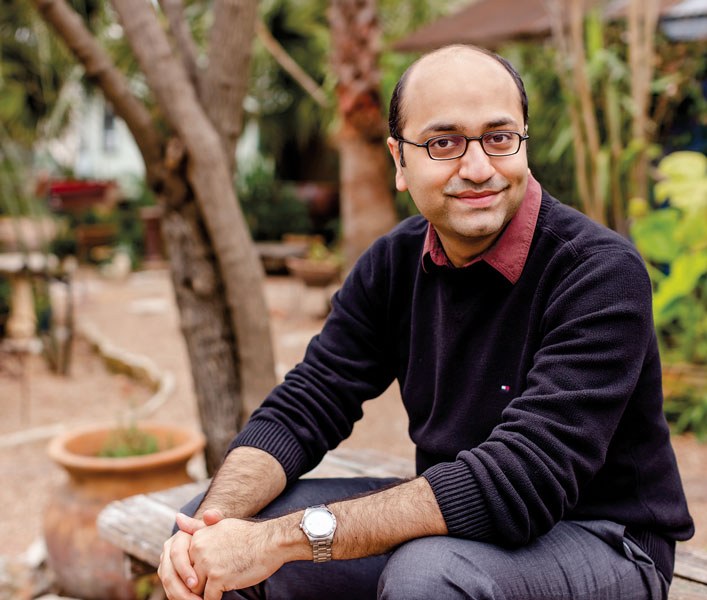
Courtesy of Ahmer Arif
How would you sum up your research? What are you trying to accomplish?
My research is on misinformation, disinformation, and how we can address these things in more human-centered ways. In human–computer interaction, we study issues at the intersection of society and technology. My specific area is understanding how misinformation, both intentional and otherwise, spreads online during periods of uncertainty, such as pandemics, natural disasters, or human-made crises. One part of my work is on the technical side, just examining these dynamics, how they unfold in these complicated environments. The other half of my work is how we can design things that can help communities respond to this spread in ways that matter to them.
In your research, you use the term information disorder; how does that term better capture the scope of the issue?
Information disorder is a term that was popularized by communications scholars Claire Wardle and Hossein Derakhshan. The term is meant to capture both mis- and disinformation, as well as malinformation—information that can be true but is used for harmful intent. It’s pointing more to the structural issues, the breakdown of order. Misinformation diagnoses a piece of content, but information disorder diagnoses the broader environment that we’re in, that everything is in chaos or disorder. And I think that does capture and help name the moment we’re in metaphorically a lot better.
Are there cultural differences across countries that come up in these online environments related to information?
My colleague Kayo Mimizuka and I have studied QAnon in Japan. Yes, there is a large QAnon presence in Japan, and the dynamic there is some groups orient around right-wing U.S. political narratives and politicians, and they have anti-vaccine views. There are lots of cultural differences in how that country deals with problematic narratives like this. One is that they have a different argument culture, a notion developed by linguist Deborah Tannen. Here in the West, such as in America, our argument culture is more combative. Think about how deeply ingrained that is in our culture: People defend their dissertations, you attack an argument, you use bullet points. Japan has a different attitude. For instance, when they have a debate, they often don’t bring two speakers to duke it out on television. They often bring three positions. There’s more of an emphasis on collective harmony and preserving the social fabric. Some Japanese communities that have tried to combat QAnon are often not trying to disprove QAnon, but rather these communities start from the idea that people may be seeking belonging or meaning, and they try to offer healthier alternatives. That’s a different approach.
How have you been able to engage with librarians and communities?
Our work was focused on using participatory design methods with communities across the nation to help them do media literacy work. We would bring together librarians from across the country into groups where they would design solutions that they think would help their communities. An example of one is called Leveling Up Seniors. You teach younger students about misinformation, how it spreads online, or how AI can help spread it. And then they have to educate seniors. The idea is that grandparents are much more likely to show up if they’re curious about what their grandchildren are doing. That kind of design, personally I would have never come up with. It took people on the ground in the communities to develop these ideas and make them real.
But this project was labeled as a DEI [diversity, equity, and inclusion] project and defunded. Community partners such as libraries had made plans and incurred costs based on that commitment. When the funding disappeared, we were left trying to piece together alternative support. We managed to figure out different solutions, finding pockets of money to help. But we spent months of our lives dealing with the fallout.
Another term you use is participatory disinformation; how does that relate to your research?
Participatory disinformation is the idea that these technologies enable us to participate in the production and dissemination of propaganda in new ways. One example is we were studying the information space around shooting events during Black Lives Matter, before George Floyd, and my colleague Leo Stewart and I saw some accounts were spreading countermessages in relation to Black Lives Matter hashtags, such as Unborn Lives Matter. They would always sign their post with this hashtag #PJNet, which we had never heard of. We went looking and found a website called the Patriotic Journalist Network. It’s this website that looks like it’s from the 1990s, and you go into this AOL-style chat room. People in this chat room were talking about just normal life stuff.What we discovered was this is actually a community of older people, and if you look at the rest of the website, they’ve handed their passwords over to a centralized actor. During most of the day, they would just be normal on their social media accounts, and then during certain times they would “lend their voice to the Twitter choir,” where their accounts would be essentially turned into bots for that time, and they would collectively start tweeting at political figures about abortion rights and other issues. We ended up calling these cyborg accounts, because sometimes they’re human and sometimes they’re robots. This is an example of participatory disinformation. They’re a community, they’re humans, they’ve found a lot of meaning together, they ask after one another. But it’s also actively spreading certain politicized narratives or problematic content. You couldn’t detect these accounts as just bots, because for most of the day they are very normal.
Looking at solutions, what are practical ways to tackle these issues?
My students’ frustration right now is they feel disempowered because we need a cultural shift, essentially, in how we make sense of information. And that doesn’t leave them with much hope, practically speaking. And my answer to that is, first, design is hope. To design solutions is to try and imagine alternative futures. Before you get to scaling it up, can we just try to get it right in one place? For me, designing for hope starts with designing local. If you can’t get it right for your immediate community, good luck getting it right for someone else.
Given the 250th anniversary of the U.S. Declaration of Independence, what is the relationship between accurate information and democracy, and how can we make that relationship healthier?
Good-quality information shapes our collective decision-making and helps it be healthier, and healthy collective decision-making helps us make good choices for democracy. The problem we’re running into at present is we have information disorder, and that is cascading into decision-making and democratic quality. Scientists have a lot of opportunities to help us imagine alternative futures and to open up the design space. What we choose to emphasize as scientists will shape the future. And we need to stand in solidarity with one another in this present moment. What’s also amazing about a problem like misinformation is it’s exposing so many people from different disciplines to one another. Computer scientists are learning from the environmental movement, and about psychology and human behavior. It’s enabling so many good conversations across disciplines. Even though scientists are under attack, they’re also banding together, and becoming more aware of problems that may have existed structurally for quite a while, but now they’re receiving more attention and collaboration in some areas. No individual one of us will be able to solve the problem, but collectively we’re addressing it in myriad ways—and that’s how progress happens, incrementally.
Click "American Scientist" to access home page

American Scientist Comments and Discussion
To discuss our articles or comment on them, please share them and tag American Scientist on social media platforms. Here are links to our profiles on Twitter, Facebook, and LinkedIn.
If we re-share your post, we will moderate comments/discussion following our comments policy.