When Inflammation Met Insurrection
By Philip A. Rea
An autumn flower might have nipped rebellion in the bud.
An autumn flower might have nipped rebellion in the bud.

History can hinge on the unlikeliest of details: a letter delayed, a storm at sea, or—as in the tale that follows—a disease that sidelined one of Britain’s top naval commanders at a pivotal moment in the American Revolution. Gout is a painful inflammatory arthritis that deposits needlelike urate crystals in the joints, most often the big toe, where it can lead to excruciating pain and swelling. It was long known as the “disease of kings” because of its historical association with expensive diets full of alcohol, meat, and other foods that are high in purines, chemicals that the body converts to uric acid. But gout can affect anyone, from overindulged royals to professional athletes on exemplary diets. The debilitating condition may have been a deciding factor not only in shaping the outcome of the American Revolutionary War, but also in exacerbating the British parliamentary antics that incited the colonial uprising in the first place.
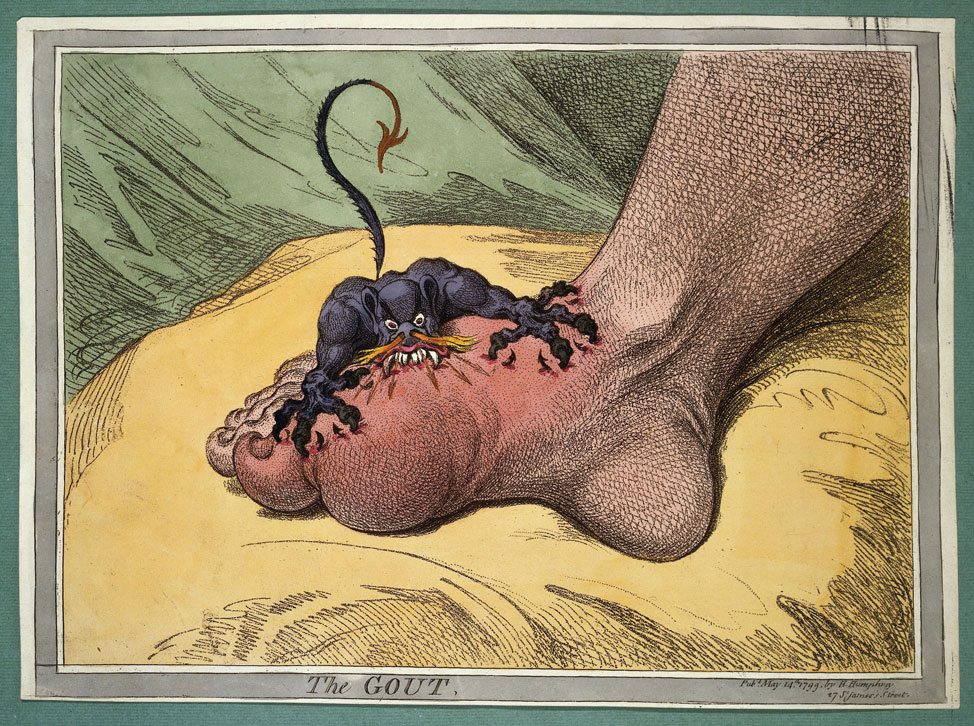
Wellcome Collection
In 1781, Admiral George Brydges Rodney was widely regarded as Britain’s most formidable seaman, a commander whose tactical innovations would influence one of the greatest admirals in history, Horatio Nelson, the British hero of the Napoleonic Wars. However as the American colonies pressed their bid for independence, Rodney was not at sea but confined to England, incapacitated by a severe attack of gout. His absence placed Rear Admiral Thomas Graves in command of the Royal Navy squadron bound for the Virginia coast, where he would face the French fleet.
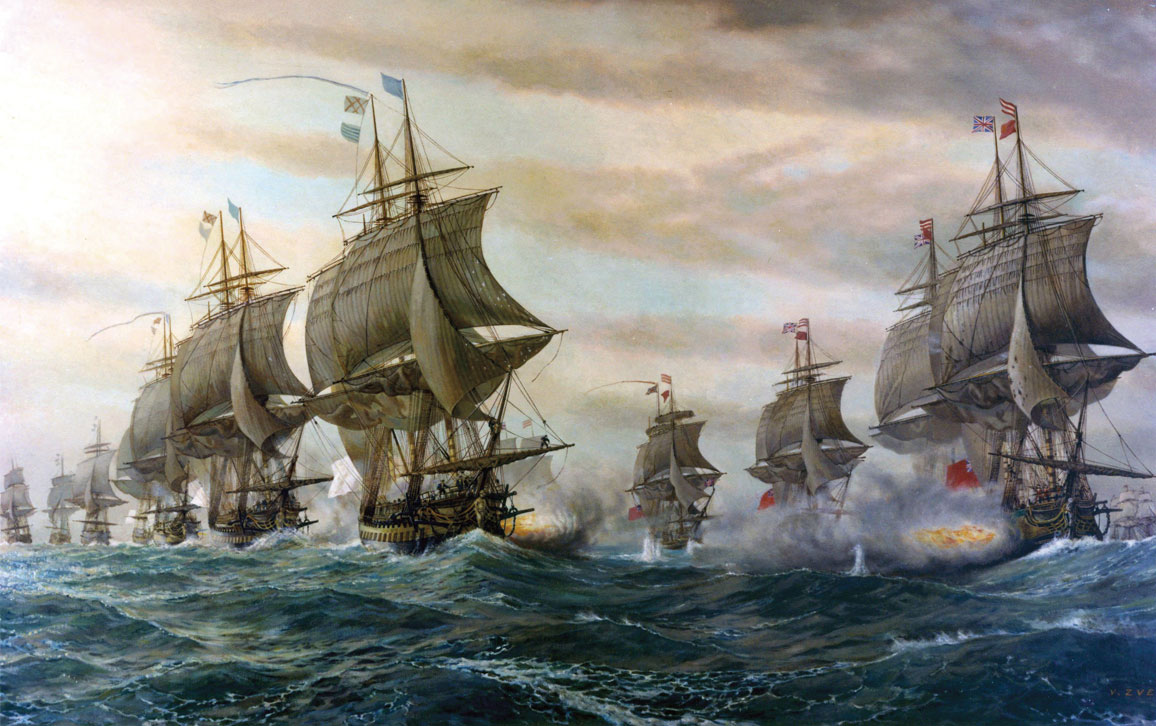
GL Archive/Alamy Images
On September 5, 1781, the two fleets clashed at the Battle of the Chesapeake, where Graves’s hesitant and indecisive maneuvers permitted French Admiral François Joseph Paul de Grasse to seize and hold control of the bay. The strategic consequences of this engagement were profound. Damaged and in a state of utter disarray, the British fleet was forced to withdraw to New York for repairs, effectively abandoning the Chesapeake and leaving its entrance unguarded. This retreat sealed the American victory: The next month, U.S. General George Washington surrounded the city of Yorktown, Virginia, and British Lieutenant General Charles Cornwallis had nowhere to turn. Cut off by land and sea, he surrendered on October 19, 1781—a capitulation that secured the independence of the American colonies.
It is not fanciful to suggest that, if Rodney’s health had allowed him to command the fleet off of Virginia, events might have unfolded differently. Six months later, leading essentially the same British ships against the same French admiral in the Caribbean, Rodney inflicted a crushing defeat at the Battle of the Saintes. There, he employed tactics that were both innovative and effective: deliberately breaking the enemy’s line and cutting through the French fleet to fracture it into isolated, vulnerable segments. That victory not only restored British naval prestige but also secured Rodney’s methods in the annals of naval warfare, shaping generations of commanders and defining the principles of modern sea combat—principles that, had they been brought to bear off the coast of Virginia, might have changed the fate of an empire.
Rodney’s incapacitation raises an intriguing medical question: Why were England’s best doctors unable to treat gout, a disease that had plagued leaders for centuries? The answer can be traced to the influential physician Thomas Sydenham.
Sydenham, revered as “England’s Hippocrates” and himself a longtime sufferer of gout, died in 1689, nearly a century before the American Revolution, but his work had a lasting impact on the nation’s medical practices. One of his strongly held medical positions was to eschew treatments for gout. In his 1683 publication A Treatise on Gout and Dropsy, Sydenham wrote, “I scruple not to affirm from a long course of experience, that most of those who are supposed to perish by the gout, are rather destroyed by wrong management, than by the disease itself.”
This assertion contradicted common practice in mainland Europe, where physicians administered a standard treatment with great success. That treatment was a tincture made from a small purple flower that blooms in autumn—the colchicum, or autumn crocus (Colchicum autumnale), which is not a true crocus but a member of the lily family. Extracts from this plant yield colchicine, a chemical that is still widely prescribed today for inflammatory conditions, most notably gout. Its use was not novel: Colchicum is described as a remedy for joint pain in the Ebers Papyrus, an Egyptian manuscript written in approximately 1500 BCE.
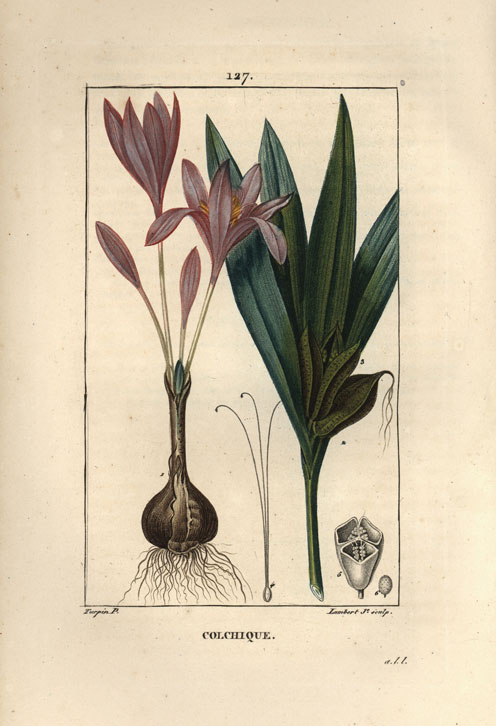
Album/Florilegius/Science Source
Yet in 18th-century England, colchicum was regarded with deep suspicion and largely excluded from respectable medical practice. Sydenham had denounced colchicum as a dangerous poison after experiencing its gastrointestinal effects firsthand. Diarrhea, nausea, and abdominal cramping—reactions now recognized as common, often dose-dependent, and typically self-limiting as the body adjusts—were in his opinion enough to condemn the drug to oblivion. The weight of Sydenham’s authority was such that, for more than a century, colchicum all but vanished from the British pharmacopoeia. In its place, Rodney’s physicians resorted to standard contemporary treatments: bloodletting, herbal poultices, and liberal doses of laudanum—including Sydenham’s proprietary tincture of this opium-derived medicine. Small wonder Rodney was slow to leave his bed.
Rodney was not the only 18th-century British leader undone by inflammation. William Pitt the Elder, considered by many to be the most eloquent parliamentary advocate for colonial rights, was repeatedly struck down by gout flare-ups. While he was convalescing from one such attack, Parliament enacted the Stamp Act of 1765 to defray the costs of defending the colonies from French invasions. The act, also known as the Duties in American Colonies Act, required that legal documents, newspapers, and many other materials printed in the colonies be produced on revenue-stamped paper.
The weight of Thomas Sydenham’s authority was such that, for more than a century, colchicum as a treatment for gout all but vanished from the British pharmacopoeia.
The act was a galvanizing issue in discussions of independence in the American colonies. When Pitt recovered, he led a movement for its repeal, insisting that “the Americans are the sons, not the bastards, of England” and that as subjects, they were entitled to representation and could not be taxed without consent.
Then gout struck again, and Pitt had to take his leave from Parliament once more. His parliamentary opponent, Charles Townshend, seized the opportunity to impose new import duties on paper, paint, lead, oil, glass, and tea through the Townshend Revenue Act of 1767. As medical historian W. S. C. Copeman quipped in his 1964 book A Short History of the Gout and Rheumatic Diseases, “This [act] precipitated the Boston Tea Party—and the rest is history.”
Strictly speaking, it was the subsequent Tea Act of May 10, 1773—which granted the British East India Company a monopoly on tea sales in the American colonies—that directly sparked the revolution. But a primary function of the Tea Act was to force colonists to accept and pay the previously imposed taxes, creating a situation of resentment. The escalating provocations of the Stamp and Townshend Acts might never have occurred had not Pitt’s recurring gout—and English physicians’ reluctance to prescribe colchicum—removed his formidable voice of restraint at two crucial moments.
Sydenham’s rejection of colchicum could not hold up indefinitely against the agonizing pain of gout. Decades later, the treatment returned to respectable British medicine, in part due to its enthusiastic use by the prince regent: George III’s son and the future George IV. If ever there was a poster child for overindulgence, it was the prince regent, a figure so extravagantly excessive that cartoonists often lampooned him for his gluttony and narcissism. His diet included rich meats and prodigious amounts of alcohol, both of which are known to raise uric acid levels and increase the likelihood of developing gout.
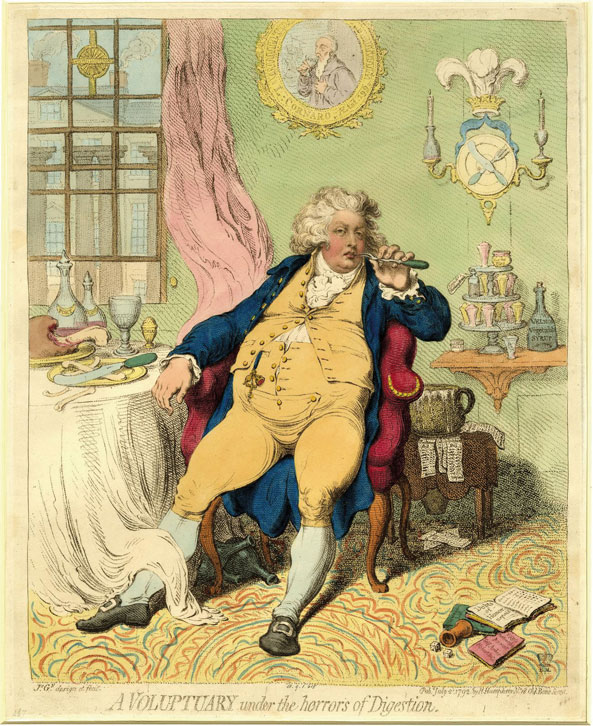
© The Trustees of the British Museum, released as CC BY-NC-SA 4.0
By 1817, these episodes had grown so frequent and intense that the prince resolved to take matters into his own hands. Defying his physicians, Henry Halford and William Knighton, who maintained that gout was best left untreated, he reportedly announced, “Gentlemen, I have taken your half-measures long enough to please you. From now on I shall take colchicum to please myself.”
His decision to self-medicate did more than challenge British medical convention; it overturned it. Colchicum became the remedy of choice among London’s elite gout patients and gained official legitimacy through the endorsement of Joseph Banks, the president of the Royal Society. Physicians belatedly set aside their English exceptionalism and accepted the treatment that the rest of Europe had embraced long before. In France, army officer Nicolas Husson had already popularized Eau de Husson, a secret elixir advertised to cure gout and a dozen other ailments. When analyzed, the potion’s active ingredient proved to be colchicine. In short, chemistry redeemed what Sydenham had condemned.
Had Sydenham accepted the healing power of colchicum, or had subsequent English physicians understood his error, history might have taken a different turn. A naval fleet might have fought with greater tactical precision, a battle might have gone the other way, and the world map might look quite different from what we see today. Who knows, perhaps even the import duties that were to fan the flames of colonial resentment and set rebellion alight might never have been imposed.
Such speculation belongs to the shadowland where medicine and history overlap, but it also offers a quiet reminder that empires, like bodies, are undone from within as much as they are conquered from without. The gout of an admiral or a statesman may seem incidental to the grand narratives of war and diplomacy, yet such ostensibly trivial inconveniences may play their part in shifting the tides of empire and quietly shaping the destinies of nations.
The autumn crocus, once scorned as poison, endures as a quiet symbol of what could have been—a flower that might have nipped rebellion in the bud had it, guided by a willing physician’s hand, bloomed a little earlier.
Click "American Scientist" to access home page

American Scientist Comments and Discussion
To discuss our articles or comment on them, please share them and tag American Scientist on social media platforms. Here are links to our profiles on Twitter, Facebook, and LinkedIn.
If we re-share your post, we will moderate comments/discussion following our comments policy.