Baby Shark Sighting Misrepresented in Media Coverage
By David Samuel Shiffman
A photograph of a small great white shark made headlines, but for the wrong reasons. The coolest aspect of the study was missed.
March 15, 2024
Macroscope Biology Communications Environment Ecology Nature Conservation Oceanography Zoology
Carlos Guana
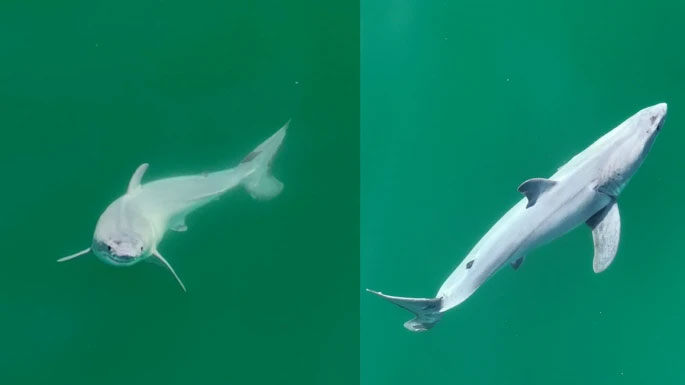
It was the baby shark seen around the world. You may have seen some recent news coverage about the photograph taken using a drone. CNN called the sighting “the holy grail of shark science.” Newsweek called it “the world’s first sighting of a baby great white shark.” USA Today claimed that it shows a “great white shark giving birth caught on video.” With headlines like these, the study is on track to be the most-discussed shark research paper of the year. Unfortunately, much of that discussion is factually incorrect, and incorrect in a way that takes attention away from real issues.
Many of the news stories about this discovery gave readers the impression that: this image unequivocally shows an hours-old baby great white shark; no one has ever seen a newborn great white shark before this image; no one has ever realized that Southern California is an important area for young great white sharks before this discovery; learning where baby great white sharks are born is the most important outstanding question in shark science; and this discovery will help protect great white sharks from extinction.
Although this study does report an interesting discovery, none of these five points are correct.
Is This a Newborn White Shark?
Maybe—it’s certainly smaller than a juvenile. But we cannot tell how old it is from a photograph. Confirmation would require catching, measuring, and sampling the animal according to established scientific protocols. “No, I am not convinced that this was a newborn great white shark,” James Anderson of the Hawaiʻi Hammerhead Research Project said. “We have no record of the physical morphological examinations needed to determine if this is actually a newborn.”
The reason people say it’s a newborn is its small size (which has only been estimated, because the animal was not caught and measured scientifically), and the presence of a mysterious milky substance covering some of the shark’s skin, which is claimed to be uterine milk. Because the only evidence here is an image and no one sampled that substance or examined the animal for signs of recent birth, we cannot say for sure how long ago it was born.
Critically, we cannot tell if a shark is newly born without examining it closely, which cannot be done by drone photography. “The best way to confirm whether a shark is a newborn is to see how well-healed their umbilical scar is,” Oscar Sosa-Nishizaki, a senior researcher at CICESE in Mexico, said.
Additionally, Chris Lowe, the director of the California State University Long Beach Shark Lab, is skeptical that newborn white sharks would even have such a coating. “A previously examined female great white shark with near-term embryos had no such milky mucus coating,” he said.
This particular white shark was estimated to be about 1.5 meter long, which has been falsely represented as the smallest white shark that anyone has ever seen, by far. Although smaller white sharks are less well studied than adults, many studies have focused on smaller animals, including several in the same area where this animal was found.
“It is well documented that coastal areas in Southern California, all the way to Baja California, Mexico, are important nursery habitats for young white sharks,” Anderson said. “White shark nursery aggregation hotspots in Southern California have been the subject of in-depth study for many years, and white shark pups have been seen at locations around the world.” A recent study led by Anderson involved catching, measuring, sampling, and deploying telemetry tracker tags on 34 similarly sized white sharks in Southern California.
Farther down the coast in Mexico, Sosa-Nishizaki said that “we have seen white sharks ranging in size from 138 to 150 centimeters with open umbilical scars, which fully heal about four days after birth.” That work was published in 2021.
Meanwhile, on the East Coast, another team of white shark scientists caught, measured, and sampled a significantly smaller animal that was just 1.22 meter long. They also managed to deploy telemetry tracker tags on 10 similarly sized sharks.
White shark reproduction is absolutely not the biggest outstanding mystery in shark science.
There have been many lists of research priorities for shark conservation science published over the past few years, including one resulting from a project I led, and none of them include “where do great white sharks give birth.” Several expert respondents to my survey explicitly noted that there are many species of sharks who are far more threatened than great whites, and research attention should shift toward understudied species of greater conservation concern. There was even a paper that explicitly focused on outstanding research priorities for great white sharks, and it does not include finding out where baby great whites are born.
Saving the Great White Shark
The press coverage emphasized the wrong message about great white shark conservation. It’s true that identifying nursery areas for sharks is an important step in the conservation of threatened species. “Knowing where nursery areas are allows us to protect places where large numbers of newborns aggregate, and can help ensure that the adult population will have new recruits to continue population dynamics,” Sosa-Nishizaki said.
In this case, however, we already knew that this region was important for juvenile white sharks, and it’s already been protected by banning gillnets that can entangle and kill young great whites (and other species). This protection has resulted in population increases of other shark species in the region. “The good news for California’s white sharks and the people who care about them is that the species enjoys more protections than most other sharks, and no area on Earth has a better white shark conservation record than California,” Sonja Fordham, the President of Shark Advocates International, said. “Experts there are documenting a recovering population achieved through a suite of regulations that over time have reduced fishing mortality and preserved habitat, but also protected prey—particularly marine mammals—and improved water quality.”
Additionally, although white sharks face conservation challenges, they are not the most endangered species of shark, and they are one of the most heavily protected species in the world already, resulting in well-documented and highly publicized population recoveries in parts of their range. Claiming that a photograph of a small shark in an area known to have small sharks will be critical for conservation is laughable. Past studies have noted that white sharks already dominate media conversations about shark conservation, while far more threatened species barely are mentioned at all.
The Real Hidden Gem
Although the experts I spoke to were critical of much of the sensationalist and inaccurate media coverage of this discovery, they agreed that the authors found something unique and fascinating: the strange milky white substance found on this shark! They just wish that it could have been sampled so that we could learn what it actually is.
“There’s something going on with that animal and whatever is on the skin,” Anderson said. “It’s never been observed before, and it piques my curiosity.”
Sosa-Nishikazi agrees: “Knowing that this area is a well-known nursery area for white sharks, you’d expect to see young white sharks there, that’s not the interesting discovery here. What is really cool for me is the whitish substance found on the shark. What is it?”
Bob Hueter, the chief scientist of the white shark research organization OCEARCH, also was intrigued by the white substance. “Whether the white film seen on this shark is some sort of uterine fluid or something completely different is unknown until we directly sample this material,” he said. “But it doesn’t look like anything that’s ever been seen before in other shark species.”
“Advances in camera technology like drones are providing cool and mostly passive opportunities to observe the wild world,” Michelle Jewell, a research associate at the Michigan State Museum, told me. “These observations help us direct where to do further research in order to generate real conclusions. This paper documented something that we’ve never seen before—a strange substance on a white shark’s skin—but now we need to do some scientific research to understand what it actually is.”
Getting the Story Right
Sharks are ecologically important animals whose population declines cause significant harm. Many species face very serious conservation challenges. The scientists who study these animals, the communications staff who write press releases about them, and the journalists who write about those studies, have a responsibility to get the story right.
American Scientist Comments and Discussion
To discuss our articles or comment on them, please share them and tag American Scientist on social media platforms. Here are links to our profiles on Twitter, Facebook, and LinkedIn.
If we re-share your post, we will moderate comments/discussion following our comments policy.