The Soul of Science
By Michael Shermer
The purposes we create in life are no less meaningful for their impermanence
The purposes we create in life are no less meaningful for their impermanence

DOI: 10.1511/2005.52.101
According to Greek legend, Poseidon's son Theseus sailed to Crete to slay the monster Minotaur. After his triumphant return to Athens, his ship was preserved as a memorial. As the vessel aged, decaying planks were replaced with new ones; eventually, all the original timber was replaced. Philosophers know the story of Theseus's ship as a classic example of the problem of identity. What was the true identity of the ship, the shape or the wood?
A more contemporary example may be found in the form of my first car, a 1966 Ford Mustang with a 289-cubic-inch engine and a speedometer that pegged at 140 m.p.h. As a young man high in testosterone but low in self-control, by the time I sold the car 15 years later there was hardly an original part on it. Nevertheless, my "1966" Mustang was now considered a classic, and I netted a tidy profit. Like Theseus's ship, its essence—its "Mustangness"—was intact.
The analogy holds for human identity. The atoms in my brain and body today are not the same ones I had when I was born. Nevertheless, the patterns of information coded in my DNA and in my neural memories are still those of Michael Shermer. The human essence, the soul, is more than a pile of parts—it is a pattern of information.
As far as we know, there is no way for that pattern to last longer than several decades, a century or so at most. So until a technology can copy a human pattern into a more durable medium (silicon chips perhaps?), it appears that when we die our pattern is lost. Scientific skepticism suggests that there is no afterlife, and religion requires a leap of faith greater than many of us wish to make.
Whether there is an afterlife or not, we must live as if this is all there is. Our lives, our families, our friends, our communities (and how we treat others) are more meaningful when every day, every moment, every relationship and every person counts. Rather than meaningless forms before an eternal tomorrow, these entities have value in the here-and-now because of the purpose we create.
In science, a fact is something confirmed to such a degree that it would be reasonable to offer our assent that it is true, provided that the assumptions on which it rests are intact. In life, purpose is provisional for the same reason—there is no Archimedean point from which we can authenticate final Truths and ultimate Purposes. In its stead, we have to validate our own facts and determine our own purposes. The self-correcting machinery of science corroborates provisional facts, and life itself provides the template for provisional purpose.
Life's most basic purpose is survival and reproduction, and for 3.5 billion years, organisms from the pre-Cambrian to us form an unbroken continuity. This alone ennobles us, but add the innumerable steps from bacteria to big brains and the countless points at which our lineage could have died and we conclude that human beings are a glorious contingency in the history of life.
Humans have an evolved sense of purpose—a psychological desire to accomplish goals—that developed out of behaviors that were selected for because they were good for the individual or the group. The desire to behave in purposeful ways is an evolved trait; purpose is in our nature. And with brains big enough to discover and define purpose in symbolic ways that are inconceivable to millions of preceding and coexisting species, we humans are unique.
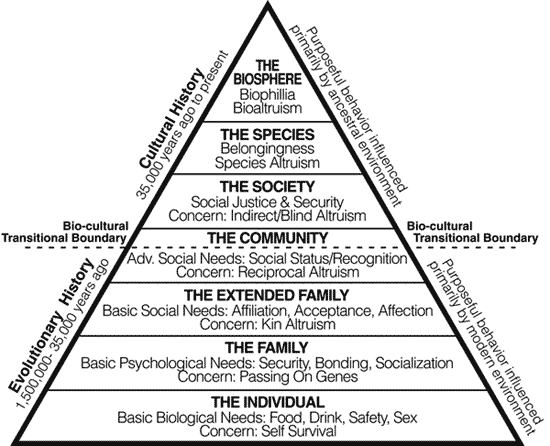
With provisional purpose we define our goals, but there is an inherent structure to the human condition that helps delimit our search. By combining psychologist Abraham Maslow's hierarchy of needs and ethicist Peter Singer's expanding circle of sentiments, one can depict the 1.5 million years over which such drives and sentiments evolved among humans and our social-primate ancestors. At the bottom of the pyramid, the individual's needs for survival and reproduction—food, drink, safety and sex—are met through the family, extended family and community. Moving up the pyramid, psychosocial needs—security, bonding, socialization, affiliation, acceptance and affection—have evolved to aid and reinforce cooperation and altruism, traits that benefit individuals and the group. About 35,000 years ago, social groups grew larger and cultural selection began to take precedence over natural selection. The natural progression of this upwards trend is to perceive societies as part of the human species and the human species as part of the biosphere.
The width of the pyramid at each level reflects the degree to which purposeful sentiment is under evolutionary control. The height of each level indicates the degree to which purposeful sentiment extends beyond us. Thus, the pyramid shows that these two variables are inversely related—the more a sentiment helps a complete stranger, the less it owes to specific evolutionary mechanisms.
Selfish genes drive kin altruism, and social relations fuel reciprocal altruism, but to achieve species- and bio-altruism, we need to learn higher-order prosocial behavior. Achieving the upper levels of the pyramid requires social and political action. We evolved in a manner in which our concern for the environment was highly restricted, and global ecology and deep time were inconceivable until recent millennia—too short a time for evolution to expand the fundamental range of our purposeful concerns.
How can we attain deep-time awareness and global consciousness when our sense of purpose is grounded in an ancient evolutionary heritage? Thomas Jefferson suggested one answer in a letter to Thomas Law in 1814: "These good acts give pleasure, but how it happens that they give us pleasure? Because nature hath implanted in our breasts a love of others, a sense of duty to them, a moral instinct, in short, which prompts us irresistibly to feel and to succor their distresses." Scientific research supports this proposition. Experiments with the "prisoner's dilemma"—a game in which one person's cooperation or defection elicits a varying payoff depending on whether the other person cooperates or defects—reveal that subjects adopt a cooperative strategy after multiple rounds, particularly when they can interact to establish trust. Usually, the most selfish thing to do—that is, gain the most in the long run—is to begin by trusting and cooperating, and then do whatever your partner does. Trust ... with verification.
Our brains reinforce cooperative behavior. In one study by James Rilling and colleagues at Emory University, subjects that played the prisoner's dilemma while undergoing functional magnetic resonance imaging (fMRI) showed that cooperation activated the same brain areas as desserts, cocaine, beautiful faces and other pleasures. These responsive areas, the anteroventral striatum (the so-called "pleasure center," for which rats will endlessly press a bar to have it stimulated, even foregoing food) and the orbitofrontal cortex (related to impulse control and reward processing), are rich in dopamine, a neurochemical related to addictive behaviors. Tellingly, the cooperative subjects reported increased feelings of trust toward and camaraderie with their game partners. In addition to dopamine, neuroscientists believe that oxytocin—a hormone produced during eating, breast feeding and sexual orgasm—plays a vital role in human bonding and prosocial behaviors. Can we use this knowledge to accentuate purposeful behavior at the personal and global levels?
Purpose is personal, and people satisfy this deep-seated need in countless ways. Among these are avenues by which we can bootstrap ourselves toward higher goals that have proven to be especially beneficial to individuals and society. These include:
Deep love and family commitment—the bonding and attachment to others increases one's circle of sentiments and corresponding sense of purpose: to care about others as much as, if not more than, oneself;
Meaningful work and career—the sense of purpose derived from discovering one's passion for work drives people to achieve goals so far beyond their own needs that they lift all of us to a higher plane, either directly through the benefits of the work or indirectly through inspiration;
Social and political involvement—as a social species we have an obligation to community and society to participate in the process of determining how best we should live together;
Transcendence and spirituality—a capacity unique to our species that includes aesthetic appreciation, spiritual reflection and transcendence through art, music, dance, exercise, meditation, prayer or quiet contemplation, thereby connecting us on the deepest level with that which is completely outside of ourselves.
My own journey up the pyramid began with falling in love, parenting a child and making the commitment to place family before self. The immeasurable joy generated by the most quotidian of family functions reinforces this commitment on a daily basis. Even with unlimited wealth, I would continue my career no differently because I have been fortunate enough to find a profession that offers more than just personal gain. As such, my work takes me ever further out of selfhood and toward global goals. Although I have visited many of the grandest cathedrals in the world and sensed a spiritual veneration of the highest order, my greatest transcendent experiences have come through the contemplation of nature in her grandeur, such as the view from Edwin Hubble's chair through the 100-inch telescope atop Mt. Wilson. From that perch, one's picture of the cosmos grows to galactic proportions, dwarfing any prior world view and yielding a perspective transcendent beyond imagination.
Although purpose may be found in countless activities, is there a principle by which we may generalize its particulars? In The Science of Good And Evil I suggested two principles of morality. First, the happiness principle: it is a higher moral principle to always seek happiness with someone else's happiness in mind, and never seek happiness when it leads to someone else's unhappiness. Second, the liberty principle: it is a higher moral principle to always seek liberty with someone else's liberty in mind, and never seek liberty when it leads to someone else's loss of liberty. In this context I would like to suggest a purpose principle: it is a higher moral principle to pursue purposeful thought or behavior with someone else's purposeful goals in mind, and never pursue a purpose when it leads to someone else's loss of purpose.
Although purpose is inherent, moral purposes are learned; thus, the highest levels of the purpose pyramid require individual volition, personal effort and social consciousness. Morality and purpose are inextricably interdigitated—you cannot have one without the other. Fortunately, nature grants us the capacity for both morality and purpose, culture affords us the liberty to reach for higher moral purposes, and history brings us to a place where we can employ both for the enrichment of all.
Through natural evolution and man-made culture, we have inherited the mantle of life's caretaker on earth. Rather than crushing our spirits, the realization that we exist together for a narrow slice of time and space elevates us to a higher plane of humanity and humility: a proud, albeit passing, act in the drama of the cosmos.
Click "American Scientist" to access home page
American Scientist Comments and Discussion
To discuss our articles or comment on them, please share them and tag American Scientist on social media platforms. Here are links to our profiles on Twitter, Facebook, and LinkedIn.
If we re-share your post, we will moderate comments/discussion following our comments policy.