Short takes on four books
By Christopher Brodie, Amos Esty, Michael Szpir, Sharlini Sankaran
The Triumph of the Fungi · Wave-Swept Shore · Conversations on Consciousness · Medicine by Design
The Triumph of the Fungi · Wave-Swept Shore · Conversations on Consciousness · Medicine by Design

DOI: 10.1511/2007.63.88
THE TRIUMPH OF THE FUNGI: A Rotten History. Nicholas P. Money. Oxford University Press, $29.95.
Plants and the fungi that infect them are the principal subjects of the eight essays in mycologist Nicholas P. Money's The Triumph of the Fungi. The book rewards its readers—including those who begin the book with little interest in fungi—by focusing on plants with obvious importance to people (chestnut and elm trees; cacao, coffee and rubber plants; potatoes, corn and wheat) and by embedding lessons about fungal biology in stories peppered with memorable detail. Featured are such giants of mycology as Bénédict Prévost, who deduced the fungal life cycle in 1807; the Reverend Miles Joseph Berkeley, who in 1846 wrote the treatise that established potato blight as the cause of the great famine in Ireland; and William Alfonso Murrill, the upstart who deciphered the pathogenic mechanism of chestnut blight in 1906. The final chapter is devoted to emerging epidemics such as sudden oak death, which is part of a terrifying spectrum of lethal conditions caused by members of the fungal genus Phytophthora. These afflictions threaten to alter the U.S. landscape more than any disease since chestnut blight, in part because of their capacity to infect so many kinds of trees: not just oaks, but also certain types of maple, fir, redwood and other species. A similar fungus infects coastal forests in Australia, where it kills 50 to 75 percent of plant species in affected areas, leading to total ecosystem collapse. These "unstoppable microbes" behave like "biological bulldozers, "says Money; they could even "signal the end of civilization."—Chris Brodie
WAVE-SWEPT SHORE: The Rigors of Life on a Rocky Coast. Text by Mimi Koehl, photographs by Anne Wertheim Rosenfeld. University of California Press, $39.95.

From Wave-Swept Shore.
Photographs of the iconic northern California coastline are fine for hanging on the wall, but they rarely feature the most interesting parts of the beach. For Wave-Swept Shore, photographer Anne Wertheim Rosenfeld pointed her lens down at the sand and rocks instead of out to sea, capturing the diverse plants, animals and algae of the intertidal zone. Biologist Mimi Koehl describes what she and Rosenfeld found on a particular stretch of shore and discusses the biophysics governing the lives of the locals (such as the tiny hermit crab, right ). She explains, for example, that clustering together allows mussels to avoid drying out during low tide on warm, sunny days, and that different species of sea anemones positioned within inches of one another can be exposed to vastly different water speeds. So on your next trip down Route 1, take time to study a nearby tide pool. As Koehl writes, "Vistas of a rocky coast can be stunning, but a deeper understanding of how the shore functions makes such a place all the more beautiful."—Amos Esty
CONVERSATIONS ON CONSCIOUSNESS: What the Best Minds Think about the Brain, Free Will, and What It Means To Be Human. Susan Blackmore. Oxford University Press, $23 (cloth), $15.95 (paper).
Why does the activity of some neurons result in the experience of a thought or a feeling, whereas the actions of other neurons don't have the same effects? What's so special about the neurons that think or feel? Put another way, how is it that physical stuff can experience the joy of eating vanilla ice cream, or, for that matter, worry about such questions? The divide between the physical world and conscious experience is called the explanatory gap, and it lies at the heart of a new book by psychologist and freelance writer Susan Blackmore.
In Conversations on Consciousness, Blackmore interviews 21 scientists and philosophers who've given some serious thought to the "gap." Blackmore admits to having done some minor editing of their comments; the result is that her exchanges with the experts are generally accessible and often quite engaging. In addition to prodding her subjects to explain their pet theories, she has them talk about their belief in free will and the question of whether consciousness can survive death. Some of the interviewees aren't very good at explaining their ideas, and Blackmore acknowledges that even she doesn't understand what some of them are trying to say—despite her valiant attempts to unpack their thoughts. Moreover, some of the theories are, as Blackmore puts it in her delightfully British way, simply "daft." However, readers are likely to find the ideas and observations of many of the interviewees—for example, those of Thomas Metzinger, Vilayanur S. Ramachandran and Bernard J. Baars—both well-grounded and thought-provoking.
It won't surprise many readers that none of the experts has a satisfying explanation for the gap. That's okay—it may be the hardest problem scientists will ever face, and brain science may be decades or centuries away from providing an answer. For now, Blackmore's conversations provide a rewarding introduction to the opinions of some of the best thinkers on the subject.—Michael Szpir
MEDICINE BY DESIGN: The Practice and Promise of Biomedical Engineering. Fen Montaigne. Johns Hopkins University Press, $25.
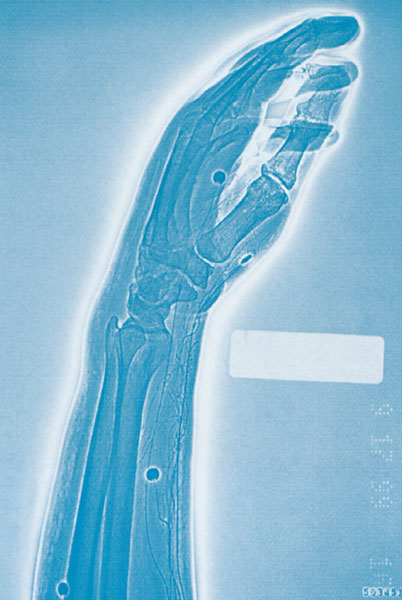
From Medicine By Design.
Medicine by Design covers the intersection of medicine, biology and engineering. The book was commissioned by the Whitaker Foundation, which funded pioneering biomedical-engineering research and education.So it's not surprising that the author, Fen Montaigne, paints a rosy picture of a future in which each patient receives technology-driven medical care, often tailored to his or her genetic makeup.
Montaigne takes the reader on a tour of academic and industrial laboratories around the United States. His interviews with young biomedical engineers, successful entrepreneurs and industry pioneers touch on subjects ranging from the familiar (cardiac pacemakers) to the newly emerging (artificial tissues). Heartwarming stories of how various medical devices have saved people's lives are liberally sprinkled throughout, yet to his credit Montaigne also relates some of the failures of these new technologies.
Surprisingly, he makes no mention of ethical issues—even as he describes such things as graduate students inserting electrodes into their own arm muscles and shocking themselves. Perhaps that is because this work led to the implanted electrodes used today to help certain quadriplegics regain use of their arms (x-ray image above right). Still, given past episodes of unethical medical experimentation on people, the lack of comment about the potential for abuse is worrisome. It is even more disturbing that Montaigne's sources depict government controls and FDA regulations as hurdles to success rather than as essential, albeit cumbersome, parts of the checks and balances of an ethical system.
Medicine by Design is written for people without specialized scientific training, but the text sometimes jarringly juxtaposes journalistic hyperbole and technical jargon. Nevertheless, the book offers glimpses into the mind-set of biomedical engineers and highlights some fascinating technologies that promise to benefit our aging population.—Sharlini Sankaran
Click "American Scientist" to access home page
American Scientist Comments and Discussion
To discuss our articles or comment on them, please share them and tag American Scientist on social media platforms. Here are links to our profiles on Twitter, Facebook, and LinkedIn.
If we re-share your post, we will moderate comments/discussion following our comments policy.