Fusion from Television?
By David Schneider
Tabletop nuclear fusion gets a second look
Tabletop nuclear fusion gets a second look

DOI: 10.1511/1999.30.0
Just over ten years ago, Stanley Pons and Martin Fleischmann announced that they had devised a way to carry out nuclear fusion on a tabletop—and captured the attention of the world. Two humble chemists, it seemed, had uncovered a simple solution to the thorny problem of making hydrogen isotopes combine and release energy in a controlled fashion. The breakthrough promised to provide humanity with an essentially unlimited power source. Their ingenious method had apparently eluded physicists, who for decades had spent billions of dollars on fusion power research without practical result. Several weeks after the initial news conference, more sober assessments of the work of Pons and Fleischmann showed little evidence that fusion reactions had actually taken place, and most scientists lost interest in the lingering debates about cold fusion.
Joshua Resnick
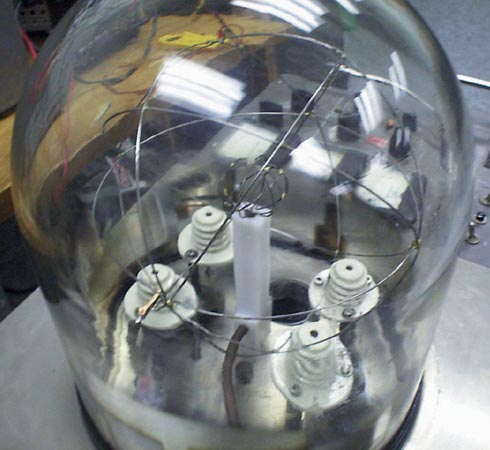
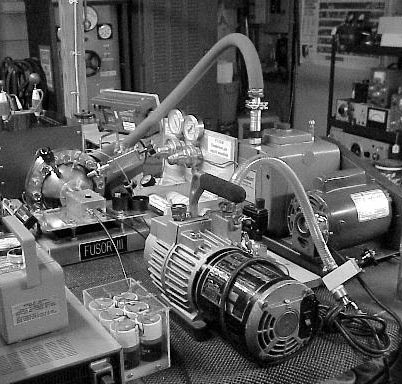
The notoriety of this episode in the history of science obscures another effort to produce tabletop fusion reactions that is more interesting and, in fact, successful. Although not quite as unassuming as the electrochemical cell that Pons and Fleischmann used, a rather elementary device can generate nuclear fusion using a technique called inertial electrostatic confinement. Indeed, the equipment is so straightforward to build that production models will soon go on sale, albeit not as power generators but as convenient sources of neutrons. Homebrew versions of this same fusion apparatus have even been built by amateurs.
The roots of this technology reach into the 1950s, when the first patent application for a novel fusion device was filed by the very person who earlier ushered in another technical marvel: the boob tube. Now recognized as the father of electronic television, Philo Farnsworth, a self-taught inventor, spent the later portion of his life investigating whether a machine that is not so different from a television picture tube could be harnessed to produce fusion reactions.
Whereas a picture tube shoots electrons into a phosphor-coated screen, Farnsworth's patent called for an "evacuated spherical electron tube" that accelerates the particles into a central zone. The cloud of negative charge in turn attracts positively charged deuterium or tritium ions toward the center, where they collide at high velocity. Although only a few nuclei hit with enough energy to allow fusion, the ions that fail to combine the first time will continue to crisscross the central region under the influence of the inward-pointing electric field. This focusing effect gives the accelerated ions multiple opportunities to fuse without losing significant energy during the failed collisions.
Robert Hirsch, a physicist Farnsworth hired in 1964, simplified the early design to accelerate the ions directly, making the device more efficient, although it was still far short of being a net producer of power. Asked to address the agency then charged with establishing nuclear research priorities, the Atomic Energy Commission, Hirsch hoped to demonstrate the value of funding further work on inertial electrostatic confinement fusion. So he mounted his prototype on a stainless-steel dessert cart and wheeled the contraption into the conference room. "Just plugging it into the wall, I think I produced 105 neutrons per second," Hirsch recalls. (His more carefully controlled trials in 1967 yielded more than 1010 neutrons per second, a benchmark that has yet to be beaten by the modern versions of this device.) Yet the AEC proved unreceptive. "I underestimated the resistance," Hirsch notes, explaining how it was difficult even then for the nuclear research establishment to consider seriously techniques other than the two now-entrenched approaches to fusion power: magnetic and inertial laser confinement.
Richard Hull
Despite the lack of attention—and funding—some physicists have spent much of the last decade trying to revive interest in Farnsworth's second invention. George Miley of the University of Illinois, for example, has worked on inertial electrostatic confinement for several years. He and his corporate partners at DaimlerChrysler Aerospace have used this method to build a compact neutron generator, one they plan to start selling within months. "End users are wary of isotopic sources," says John Sved, the project manager at DaimlerChrysler, referring to the means some others employ (a radioactive isotope such as californium-252) to generate neutrons. Others in need of these particles, say, for conducting neutron-activation analysis, must place their samples in a nuclear reactor. So having a portable neutron source that can be flipped on and off with the push of a button would be a great advantage. Although switchable neutron generators (small particle accelerators) are available commercially, Sved anticipates that his product, lacking the usual solid target for the speeding ions, will have a longer service life.
Richard Nebel and his colleagues at Los Alamos National Laboratory are also constructing an inertial electrostatic fusion device. They anticipate that their equipment will prove useful in the short run as a high-intensity neutron source for characterizing radioactive materials. Over the longer term, these physicists hope they can refine the basic concept to the point where inertial electrostatic fusion could produce useful amounts of power.
Robert W. Bussard, a physicist who founded the Energy/Matter Conversion Corporation of San Diego (which goes by the clever acronym EMC2) is also experimenting with inertial electrostatic confinement fusion. The U.S. Navy has supported him with about $4 million since 1995, in hopes that this technique will someday provide a compact fusion power source. Although practical realization may be far off, Alan Roberts, the official in charge of this Navy research program notes, "You can't put a tokamak on a ship."
Could Farnsworth's dream of generating fusion energy using a technique spawned from the development of the television set ever become a reality? The people now pursuing this approach are understandably enthusiastic. But Hirsch, who left lab work for a career in management three decades ago, has perhaps a more compelling perspective. He asks why the government has largely neglected various methods (like inertial electrostatic confinement systems) that are small in scale and could be studied for much less money than is now being spent on the colossal facilities needed to advance magnetic and laser fusion. And given his extensive experience—as director of federal fusion research for four years and as a vice president for the Electric Power Research Institute, among other high-level posts—his question seems too important to ignore—David Schneider
Click "American Scientist" to access home page
American Scientist Comments and Discussion
To discuss our articles or comment on them, please share them and tag American Scientist on social media platforms. Here are links to our profiles on Twitter, Facebook, and LinkedIn.
If we re-share your post, we will moderate comments/discussion following our comments policy.