Behaviorism at 100
By Stephen F. Ledoux
Over its second 50 years, the study of behavior evolved to become a discipline, behaviorology, independent of psychology.
Over its second 50 years, the study of behavior evolved to become a discipline, behaviorology, independent of psychology.

DOI: 10.1511/2012.94.60
Behaviorism as a philosophy of science began with an article by John B. Watson in 1913, and its several varieties inform different behavior-related disciplines. During the past 100 years, disciplinary developments have led to a clarified version of behaviorism informing a basic, separate natural science of behavior.
Bettmann/Corbis
This recently emerged independent discipline not only complements other natural sciences, but also shares in solving local and global problems by showing how to discover and effectively control the variables that unlock solutions to the common behavior-related components of these problems.
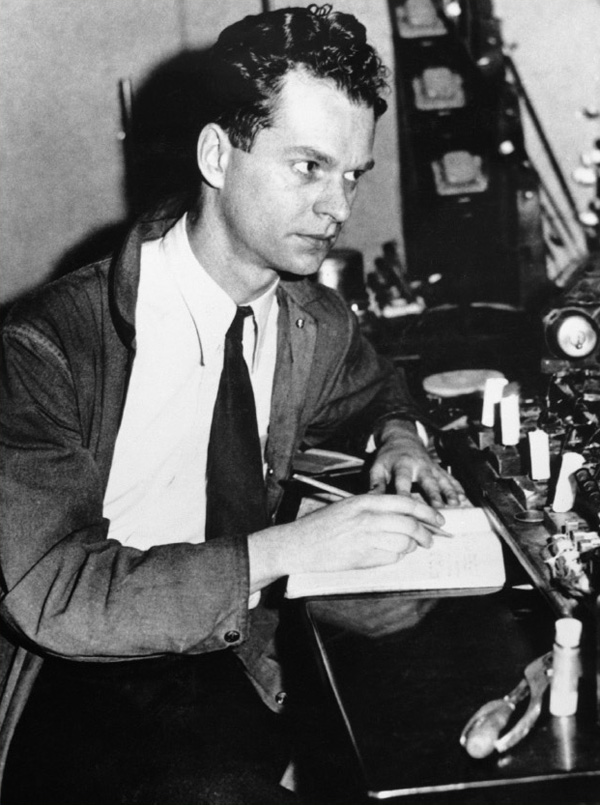
In 1963, B. F. Skinner published “Behaviorism at 50,” reviewing the varieties of behaviorism and the directions of natural behavior science. (The 1957 article reproduced nearby covers many of those topics.) By the 1960s common wisdom held that the experimentally discovered laws of behavior were largely irrelevant to normal human beings; instead, they were thought applicable mostly to treating psychotic individuals and to training animals. Skinner challenged that notion on scientific as well as philosophical grounds, and data accumulating over the next 50 years have validated his position that the natural laws governing behavior are relevant to all behavior of human beings and other animals. The 1960s were also a time when natural scientists of behavior were continuing their attempts to change psychology, the discipline in which many worked, into a natural science. Over the next 50 years, as recognition increased that resistance to those efforts was adamant, natural scientists of behavior gradually took their discipline outside psychology, founding a separate and independent natural science that some recognized formally in 1987 using the name behaviorology. That name is synonymous with “the natural science of behavior” and is conveniently shorter.
With behaviorism turning 100 in 2013, a review of those developments, and their implications for other natural sciences and today’s world, seems appropriate. The natural science of behavior can elevate the status of the natural sciences, lead to solving more human problems, reduce susceptibility to superstition and mysticism (both theological and secular), and improve human intellectuality, rationality and emotionality.
Naturalism, the general philosophy of science, can enable those outcomes. Natural scientists maintain a mutual respect for the natural functional history of events. This enables their analyses to be more complete and to track well across disciplinary lines. In contrast, ignoring that natural functional history often leads to unnecessary compromises between some natural sciences and nonscientific disciplines that make claims of mystical origination of events. For example, by respecting the natural history of events, physiology can provide additional details about how an energy transfer evokes a behavior (such as how light striking the retina from a close moving object evokes ducking the object). At the same time, chemistry can provide more details about that physiology, and physics can provide still further details about that chemistry. But if natural scientists instead allow claims that ducking is, or results from, the spontaneous, willful act of some putative inner agent, then an untraceable, untestable mystical account replaces the links in that natural history. When such compromises give undeserved status to mystical accounts, natural science loses ground, reducing its benefits. Maintaining respect for the natural functional history of events thus enables a more complete and consistent account of any phenomenon, including behavior.
Becoming more aware of the progress that scientists have made on behavioral fronts can reduce the risk that other natural scientists will resort to mystical agential accounts when they exceed the limits of their own disciplinary training. The aim here is to provide some highlights of that progress.
During the second 50 years of behaviorism, developments continued in both the philosophical and experimental areas, but they also expanded into the applied sciences and organizational realms. In expanding naturalistic explanations toward a more complete scientific account of behavior, the question of consciousness attracts the most attention. Basically, this science accounts for behaviors of consciousness in terms of neural behaviors such as awareness, thinking, observation and comprehension. While muscle behavior is more familiar, as it intertwines both neural processes and enervated muscle contractions, the behaviors of consciousness manifest as pure neural processes. Behavior is a natural phenomenon that happens, and changes, because variables affect the particular body structures that mediate it. No mysterious inner self-agent does the behaving or instructs the body to behave. Instead, respondent and operant conditioning processes occur nearly continuously. Both involve energy transfers between the environment (internal and external) and the body in ways that alter neural structures and thereby produce a different body that mediates behavior differently on future occasions.
Those points emphasize one of the major developments bearing on the question of consciousness in the years since 1963, namely the greater appreciation of the valuable overlap between the separate yet complementary natural sciences of physiology and behaviorology. For example, to deal scientifically with emotion requires the different analytical levels of these two disciplines. Emotion refers to a release of chemicals into the bloodstream (an area of physiology) that external or internal stimuli elicit (an area of behaviorology). That changed body chemistry produces the reactions called feelings. Perhaps more importantly, that changed body chemistry produces effects on other responses. When a bear startles you, you run faster than you would under more ordinary circumstances. Or, excising the fictitious inner agent that the bear or the word “you” can mistakenly imply, the sudden appearance of a big brown bear from behind a boulder only a meter away evokes faster running—due to the elicited body-chemistry change—than more ordinary circumstances evoke.
Still, behaviorology is not a science of how a body mediates a behavior, for example, of how striated muscle contractions are a function of neural processes, which is part of physiology. Rather, behaviorology is a science of why a body mediates a behavior, that is, of the functional relations between independent variables such as a boulder blocking a forest path, and the dependent variables of body-mediated behavior, such as the muscle contractions that the obstacle evokes which take the body around the boulder.
While behaviorology accounts for specific functional relations between real independent variables on both sides of the skin and real dependent variables of behavior changes on both sides of the skin, brain physiology accounts for the structural changes that occur as those behaviorological-level independent and dependent variables interact. That is, brains mediate behavior that occurs as a function of other real variables; brains do not originate behavior. Thus, the more brain physiologists work to account for the mediation of behavior, particularly neural behavior, the greater success they experience.
With the enhanced accounting for complex human behavior that Skinner’s analysis of verbal behavior provides, the natural science of behavior has also addressed some ancient fundamental questions, leading to an exciting outcome. Since what scientists and philosophers and other knowers “do” is behavior, behaviorology is providing scientific analyses of science, philosophy and epistemology. By the 1990s such analyses also covered attitudes, values, rights, ethics, morals and beliefs, with important implications for a range of engineering concerns including robotics. These kinds of scientific extensions of behaviorology led Lawrence Fraley, in Chapter 29 of his General Behaviorology, to conclusions about reality that parallel those that Stephen Hawking reached in his Grand Design, through the logic of naturalism in physics, that our neurally behaving reality is the sole source of knowledge about reality, because we can get no closer to reality than the responses evoked by the firing of sensory neurons.
A related question arises, both on its own merits and due to its relevance to accounting for consciousness: How can we apparently respond to events that seem to be in the past or future? The basic answer is that we cannot; responses, like stimuli, take place only in the present, an important implication being that all behavior is new behavior. Every behavior occurs under the functional control of current evocative stimuli regardless of the complexity, multiplicity or interactivity of those stimuli or responses. Even memories are not stored responses. They are new responses that current stimuli evoke and that current neural structures mediate, neural structures that have their current structure because conditioning processes changed them both at and since the time of the original instance.
With our now more fully informed perspective, we return to address consciousness more completely. Using the vision modality for convenience, Skinner had described consciousness as “seeing that we are seeing” (known as “conscious seeing”). But he excised any implied inner agent who “does” the seeing by pointing out two general kinds of contingencies. Our physical environment supplies the kinds of contingencies that condition seeing in the first place (called “unconscious seeing”), while our verbal community supplies the kinds that condition both our conscious seeing and our reporting of what is seen. The thing seen evokes our initial unconscious seeing responses, which in turn evoke the seeing/reporting conscious responses. Actually, the thing seen need not be present because other real variables can evoke the unconscious seeing response, which can then evoke conscious seeing/reporting responses. Equally pertinent, when current independent variables are insufficient to compel the conscious part to happen, it does not.
The verbal community conditions such seeing and reporting because doing so accrues benefits. In common terms, more effective social organization and discourse arise when the verbal responses (reports) of what we did, are doing and are about to do provide stimuli that evoke the responses of verbal community members. As members of that same verbal community, we also benefit when our own seeing and reporting evoke our own subsequent responding, for such reporting also evokes our own hearing responses which then naturally supplement the controls on subsequent responses. Often these events happen covertly as one type of conscious neural behavior called thinking, a common and vital addition to the controls on subsequent behavior (since single stimuli seldom control responses). As with all neural behavior, this thinking behavior can be difficult to separate from the neural physiology that mediates it. Still, as with all behavior, independent variables must evoke the neural behavior, including thinking.
Although we sometimes benefit from the economy of common language, it usually curtails scientific sensitivity to the natural status of human behavior. Having developed under primitive conditions that seemed to support personal agency, the common language per se unsurprisingly contains explicit and implicit references to inner agents. Thus, avoiding it in scientific discourse is best, even though it seems comfortably familiar to most audiences. However, the technical language of natural behavior science, which works to exclude agential implications, can still sound overly complicated to new audiences even as these audiences experience an improved scientific sensitivity to the natural status of behavioral phenomena, including consciousness.
Some examples relating to the central concern about consciousness may help. While these use the seeing sense modality, other examples could use other sense modalities. As an example of unconscious seeing, a hiker engaged in a focused conversation with a companion will step over an unconsciously seen football-size rock on the trail but later cannot describe that rock, as it was not consciously seen. Conscious seeing examples are necessarily more complicated, as they usually begin with unconscious seeing. For instance, under some current, relatively simple contingencies involving functional chains of external and internal (neural) stimuli and responses, a favorite kind of car is seen; it is a “favorite” kind of car due to the past variables with which it was paired. Later, unconsciously and consciously seeing the favorite car happens again under other contingencies, often with that car absent, as when, unable to get to work, seeing our old, broken down, rusty wreck in the front yard evokes seeing the favorite car replacing the wreck. Still other variables can evoke conscious seeing. When we see an acquaintance at the grocery who sells cars, that person evokes not only consciously seeing both our wreck and our favorite kind of car (neither of which is present) but also evokes the responses of describing the favorite car, asking where to buy one, how much it will cost and so on.
These responses, unconscious seeing then conscious seeing and thinking, and sometimes reporting, are typical examples of the natural phenomena of responses chaining into response sequences usually including neural responses, all in the present, all new and not requiring the thing seen to be the current source of evocative stimulation. A physically present object transferring energy to neural receptors can be an evocative stimulus, or a neural response can function as an evocative stimulus either when a genetically produced neural structure mediates it or when a neural structure that various continuously operating conditioning processes have changed mediates it. If the necessary conditioning has occurred, then once some stimulation evokes a response, that response—as a real event—can evoke a further response, which can evoke yet another response, and so on, chaining according to the current set of operating functional relations. As natural scientists, we respect the functional natural history of even extremely complex and multiply controlled response chains, such as the text composition responses of this author at this moment of writing. While it is economically wasteful to bother with the detailed analysis to identify and describe the range of variables compelling the present wording, Norman Peterson, Fraley and Skinner have provided, in their textbooks, the foundations for making such an analysis, and it will take place under appropriate contingencies.
All these considerations involve extensions of the philosophy of science that Skinner called “Radical Behaviorism.” It is radical in the sense of comprehensive or fundamental, and it informs both the naturalistic experimental science that studies human nature and human behavior, and the derivative engineering technologies of that science for effectively addressing independent variables in ways that bring about improvements in behavior at home and work, in education and diplomacy, in interpersonal relationships, and indeed in all applied behavior fields from advertising to zoo keeping. This philosophy, and the science and technology that it supports, first arose among a thoroughly naturalistic group of researchers and academics, working in early-20th century psychology, that Skinner and his colleagues and their students best represent. However, this natural philosophy, science and technology ultimately proved to be fully incommensurable with the more commonly available, agential perspectives of certain fields that popular culture supports, including psychology. As a result, a separation of disciplines was required.
That essential incommensurability, and the growing pressure of expanding experimental and applied research, provided the principal driving forces behind reorganizing the natural science of behavior as a separate and independent discipline. The general result of this development is a foundation natural science related to all other natural sciences, not at the level of body-directing self-agents, but at the level of a body’s physics-based interactions with the external and internal environments. Working in this natural-science tradition, Skinner’s treatment of behaviorism in his 1963 article was well rounded but necessarily minimal. A decade later his book About Behaviorism provided details and helped pave the way for the sometimes-controversial steps in this reorganization, steps that Fraley and I thoroughly cover in our long paper entitled “Origins, Status, and Mission of Behaviorology.”
After some small independence-oriented steps (for example, Skinner and his colleagues founding the explicitly natural-science Journal of the Experimental Analysis of Behavior and Journal of Applied Behavior Analysis), by 1974 natural scientists of behavior had established what has become their largest professional organization, the Association for Behavior Analysis International (ABAI). Margaret Peterson reported the importance of this event by quoting an early president, Nate Azrin: “What we are witnessing … may be … the birth of a new discipline … separate from psychology.” The 60 worldwide chapters of ABAI report around 13,000 members, and the annual ABAI convention bookstore features more than 1,000 behavior-science titles.
From the beginning, ABAI members emphasized political action on professional, social and cultural fronts. As important as these activities were, they distracted the organization from wholeheartedly pursuing its independence. As a result the credibility problems that inhere in gradually separating from another discipline, while still being seen as part of it, remained.
Exacerbating the controversy, behavior analysts took those and other independence-oriented steps while still a part of psychology, causing the psychology discipline to claim behavior analysis as part of itself. This leaves others, including natural scientists in general, continuously unsure and justifiably suspicious about the status of behavior analysis. While the current majority of natural scientists of behavior may still prefer the behavior-analysis label, they have taken few steps over the decades to clarify its status, and some still support its being under psychology’s wing. Consequently, using that label as a disciplinary name for a completely independent natural science of behavior remains problematic. As a result, formal separation required adopting a new disciplinary name, one free of connections with nonnatural disciplines.
In the years 1984–1987, an extensive debate filled the published behavioral literature regarding, pro and con, the question of separating the natural science and philosophy of behavior from psychology. In 1987, this culminated in a group of behavior analysts meeting to reassess the situation and take action. They came to several conclusions. First, if data from a half-century of continuously attempting to change psychology into a natural science from within, by invoking standard, evidence-based methods, had failed to produce even slight movement in that direction, then changing psychology was not going to happen within a meaningful time span. Second, their natural science of behavior was not, and never actually had been, any kind of psychology as it had never accepted the basic psychological core of mystical agential origination of behavior. And third, instead, their already well-established natural science should continue as a fully separate and independent discipline called behaviorology, a term first proposed in the late 1970s, and the only one, from among all proposed names, to have survived and grown in use.
Based on those conclusions, these behaviorologists took steps that led to their current professional organizations, The International Behaviorology Institute (TIBI) and the International Society for Behaviorology (ISB), and to the journal Behaviorology Today. Most behaviorologists also continued supporting the beneficial behavior-engineering efforts that ABAI disseminates.
Highlighting three of the many areas of experimental research can indicate the range of important findings discovered in the past 50 years. These three areas are schedules of reinforcement, recombination of repertoires and equivalence relations.
As Skinner relates in his 1957 article, reinforcers are postcedent stimuli whose occurrence produces increases in the frequency of the behaviors that they follow, and schedules of reinforcement are the patterns of intermittently occurring reinforcers. These schedules are defined in terms of either the number of responses since the last reinforcer (called ratio schedules) or the amount of time since the last reinforcer (called interval schedules). The values of either type can be fixed or variable, thereby defining the four fundamental intermittent schedules of reinforcement: fixed ratio (FR), variable ratio (VR), fixed interval (FI), and variable interval (VI). Researchers often combine or otherwise rearrange the elements of these basic schedules to study a range of more complex schedules.
Outside the laboratory VR schedules are common. They produce relatively rapid and steady response patterns. Purveyors of games of chance had intuitively arranged VR schedules that control the behavior of their players centuries before science discovered and analyzed this schedule. VR schedule effects (not the “gambling habits” of inner agents) are responsible for much citizen wealth reduction.
Schedule research has repeatedly led to several general conclusions, including these three: Many features of behavior emerge as the effects of particular reinforcement schedules. Schedules with only subtle differences often produce distinctly different response patterns. And the direct effects of schedules of reinforcement reduce a wide range of putative inner-agent emotional and motivational causes of behavior to misleading redundancies.
Highlighted next is the experimental research concerning recombination of repertoires, with important implications particularly for scientific, engineering and educational problem-solving behavior. In the 1980s Robert Epstein and Skinner coordinated some studies at Harvard called the Columban Simulation Project in which pigeon behaviors that were functionally related to explicit variables simulated complex human behaviors. Some of these complex behaviors concerned novel behavior, symbolic communication, and the use of memoranda and tools. The result of this research was a more objective explication of complex human behaviors. The same kinds of common contingencies known to be producing the pigeon-simulated behaviors were at work with the human behaviors.
The pigeon simulations began with analysis to establish the minimum repertoire components likely needed to produce a complex behavior when a challenge situation confronts the organism. Then, for each pigeon subject, after conditioning each required repertoire component (in isolation from other components, to avoid confounded results), the experimenters placed each pigeon in the challenge situation. The researchers found that, for different problematic tasks, once all the necessary component repertoire parts had been conditioned, then (and only then) the challenge situations evoked successful responses appropriately combining the trained repertoire components.
For example, many proud parents have watched as their child, too short to get a cookie from a jar atop a table and having never faced this situation before, looks around and, spotting a chair, moves it over to the table, climbs on it and retrieves a cookie from the jar, putatively due to something called insight. In experimenting to discover the variables involved in this situation, the researchers came upon three pigeon response classes using boxes and toy bananas. They conditioned the birds with no banana present to push a box around the chamber toward a target spot and, separately, to climb on a stationary box and, still separately, with no box or target spot present, to peck a toy banana within normal reach. These response classes approximated the components of the child’s cookie retrieval behavior. Finally, they placed each bird in a chamber with a box to one side and a toy banana suspended from the ceiling, a challenge situation that had never confronted the birds before. With some apparent confusion and sighting, like the child’s behavior, the birds pushed the box under the banana, climbed on the box and pecked the banana. Does this mean these birds showed “insight?” Was the child’s behavior due to insight, or was the child’s behavior also an example of previously conditioned repertoires combining under a novel circumstance? We do not usually observe children closely enough to track the conditioning of various repertoire components, but parsimony still requires accepting that the challenge-meeting responses are not a function of supposed higher mental processes, for pigeons or humans. Rather, they are a function both of the organism’s history having included the conditioning of relevant repertoire parts and of the current evocative control in the new pattern of related multiple stimuli in the challenge situation.
That line of research benefits the analysis of problem solving as well as enhances the justifications for multi-disciplinary education in science and engineering training curricula. As the range of an individual’s conditioned repertoire of behavior expands, so does the likelihood that needed parts are available to combine successfully in new circumstances for which no explicit response has previously been directly conditioned.
Apparently related to recombination of repertoires in ways that are still being explored, stimulus equivalence is the remaining experimental research area highlighted here. After explicitly conditioning some functional relations between environmental antecedent or postcedent stimuli and responses, the number of related behavior-controlling functional relations that we can successfully detect is greater than the number originally involved in the explicit conditioning. Researchers in this area have come to call these explicitly and implicitly conditioned relations equivalence relations .
Equivalence relations can transpire in fairly simple circumstances. For example, to train a cloakroom employee, we might first reinforce a trainee such that when shown a regular customer, Ms. Minkowner, and then shown a group of coats, including her pink mink coat, the Ms. Minkowner stimulus reliably evokes the trainee’s response of picking up her pink mink coat. Then we reinforce the trainee such that when shown the pink mink coat and several different coat-hanging cubicles, the pink mink coat reliably evokes the trainee’s depositing that coat in a particular cubicle, say, number seven. With no further training, we find that Ms. Minkowner’s appearance at the counter reliably evokes the trainee’s movement to cubicle number seven from which the trainee retrieves the pink mink coat.
Beyond such simplistic examples, researchers in this area have demonstrated the phenomena in far more complex circumstances. Using, for example, 6 sets of 3 stimuli each, explicit conditioning of a particular 15 environment-behavior functional relations turns out implicitly to condition an additional 75 behavior-evoking functional relations. In this instance, conditioning 15 particular relations can produce a total of 90 testable relations!
The implications of equivalence phenomena for a science-based revolution in, say, education can be substantial. More careful arrangements of what we would scientifically call educational conditioning programs can economize by explicitly conditioning only certain evocative functional relations, relevant to the subject matter, in ways that virtually guarantee the implicit conditioning of many other possible and relevant relations evocable by the same broad set of stimuli.
Although physiological research has yet to elucidate how the cellular and molecular mechanisms of respondent and operant conditioning work and contribute to equivalence relations, most researchers credit natural selection with the production of bodies that these processes can change in varying degrees. For example, if their genes happened to include variations that produced neural structures enabling the mediation of even a small extension of equivalence relations, then proto-species members could benefit from the survival and reproductive advantages conferred by the sort of “intelligence” that these emergent “abilities” imply. Over millions of years, the accumulation of such selected variations would result in genetically produced nervous-system structures of increasingly sophisticated potential. As a result, humans today inherit neural structures that generally mediate a relatively extensive range of equivalence relation phenomena.
Beyond experimental research, the past 50 years have seen an explosion of studies applying natural philosophy and science to practical problems. Touching on two applied-research areas, Project Follow Through in education and the refining of best practices for work with autistic children, barely suggests the extensive range of such concerns.
Project Follow Through was the most extensive and expensive federally funded educational experiment in U.S. history. It looked at how the outcomes of children taught with a range of instructional models, sponsored on voluntary district-wide bases, compared with the outcomes from children whose school districts across the country had not adopted any particular model.
The results led to a major observation: Although some models produced poorer outcomes than those of the control group, others produced consistently better outcomes, particularly the Direct Instruction and Behavior Analysis models. These successful models were explicitly based on the application of the principles and concepts of the natural science of behavior. This research had predictably revealed some science-based instructional approaches that work in education.
However, this revelation of best practices for regular education is widely ignored. Although the results of Project Follow Through focused mainly on student outcomes from the first several years of the project, the funding of various of its models continued for many years. Unfortunately, this funding was not limited to the models that produced improved student outcomes. C. L. Watkins concludes that suggestions to solve the problems of education include attempts to “change just about every structural and functional aspect of education except how children are taught.” Sadly, this indicates not only some blind respect for ineffective methods but also some persistence of the discredited notion that behaviorological laws are largely irrelevant to normal humans.
In the other applied-research example, best practices for work with autistic children have achieved greater recognition than best practices for regular education. Most of the research initially applying core behaviorological principles and concepts to a wide range of practical concerns, including interventions for autistic children, occurred before behaviorology emerged as an independent discipline. Consequently, many people refer to behaviorological practices with the term applied behavior analysis (ABA). The success of the ABA autism-related practices has made them the preferred intervention, especially for children diagnosed at a young age. For example, in 1999 the New York State Department of Health completed a multiyear project to evaluate the research literature on the numerous types of available autism treatments so as to make intervention recommendations based on scientific evidence of safety and efficacy. In its final report, the only intervention for autism that the department could fully recommend was ABA.
With its informing philosophy of radical behaviorism, behaviorology contributes to the capabilities of other natural scientists in important ways. So many of the seemingly intractable problems facing humanity today are problems of human behavior as much as they are problems of physics or chemistry or biology. In a 2007 speech, Frederick A. O. Schwarz Jr., the 17-year leader of the Natural Resources Defense Council, acknowledged the importance of changing peoples’ behavior as part of solving world problems and implicitly added a plea for coordination with an effective natural-science of human behavior. “Global warming is the greatest threat we face, but it is not the only threat.… Too many wild places are disappearing, too many species are being snuffed out, and too many babies are being born with bodies and brains damaged by man-made chemicals and pollution.… To win [these battles] … we must change how people think—and how they act.” The solutions to such problems require natural scientists of all relevant subject matters to work together. In part, behaviorologists moved decisively for formal independence when they did, so that their science could contribute to the expertise and energy needed to solve such problems within the necessary time frame; under these circumstances, they concluded that not going independent—instead spending much energy over many more likely fruitless years trying to change psychology—would be essentially irresponsible.
The behaviorology discipline contributes in other ways to the capabilities of other natural scientists. After becoming basically familiar with behaviorology, scientists in many disciplines are more able to remain naturalistic in dealing with subject matters at the edge of, and beyond, their particular specializations, rather than slip into the compromising use of agential accounts. They may also add desirable details to accounts within their specializations. For example, when natural scientists (Sam Harris and Michael Shermer, for example) say that science can account for morals and values, mentioning the controlling relations that behaviorology describes for these topics strengthens their point. Also, behaviorology provides the students of natural scientists with a natural-science alternative to the nonnatural disciplines that these students currently study when covering behavior-related subject matter.
For their part, other natural scientists can also help themselves by contributing to behaviorology through support for the wider availability of academic behaviorology programs and departments. Increasing the contact that most people have with behaviorology can reduce the interference in solving problems that stems from susceptibilities to behavior-related superstition and mysticism. This need is difficult to meet because, as a result of the historical circumstances of the origins of their discipline, many academic behaviorological scientists remain scattered in departments of nonnatural disciplines. A meaningful amount of contact for most people will not happen until behaviorology is a requirement in high-school science curricula along with physics, chemistry and biology. To achieve that goal, science teachers must have behaviorology courses available in their college training programs. To make those courses available, faculty to teach them must be trained in this discipline. And for that to happen, programs and departments of behaviorology need to become more widely established at colleges and universities.
One of the obvious places from which to grow behaviorology in the academy is from within departments of biology. Skinner recognized early in his “Behaviorism at 50” article that the natural science of behavior was an offshoot of biology. As he described in The Shaping of a Behaviorist, even though he was earning his doctorate through the psychology department at Harvard University in the 1930s, much of Skinner’s work occurred under W. J. Crozier, who headed the physiology section of Harvard’s biology department and who had been a student of biologist Jacques Loeb. Both Crozier and Loeb not only emphasized studying the whole organism, including its movement (behavior), but they also emphasized studying the causal mechanism of selection which Skinner subsequently adapted from biology and applied to behavior.
In its second 50 years, the value and legacy of behaviorism broadened substantially. The natural science that Skinner’s radical behaviorism supports and informs has emerged as an extensive, multifaceted discipline, although its independence as behaviorology only began about a quarter-century ago. Its academic homes will continue to expand because of the effectiveness of approaching human behavior naturalistically. Other disciplines faced similar circumstances in the past and prevailed. The astronomical discoveries by Galileo 400 years ago helped move our home, the Earth, beyond superstitious, mystical accounts. The biological discoveries of Darwin 150 years ago helped move the human body beyond superstitious, mystical accounts. And, based on the naturalism of Skinner’s radical behaviorism, the current discoveries of behaviorological science help move human nature and human behavior beyond superstitious, mystical accounts. On that basis, our continuing efforts both improve effective scientific thinking across all subjects, and increase success in solving personal, local and world problems.
Click "American Scientist" to access home page
American Scientist Comments and Discussion
To discuss our articles or comment on them, please share them and tag American Scientist on social media platforms. Here are links to our profiles on Twitter, Facebook, and LinkedIn.
If we re-share your post, we will moderate comments/discussion following our comments policy.