This Article From Issue
March-April 2026
Volume 114, Number 2
Page 121
Ad Left
METAMORPHOSIS: A Natural and Human History. Oren Harman. 384 pp. Basic Books, 2025. $34.
Metamorphosis represents one of life’s most mysterious processes: transformation. From the pupae of insects to the transitions of human life, scientists, poets, and philosophers have tried to make sense of metamorphosis for more than 2,000 years. Oren Harman’s Metamorphosis: A Natural and Human History is not just an account of biological processes, but a meditation on identity, time, and the human longing to understand how change happens.
Harman approaches the subject from two main perspectives. First, he asks: What is metamorphosis? How does it work, and why must it exist? Why must living beings struggle to change? Second, he considers a more philosophical question: As humans, how is it possible that we remain “the same” while changing all the time? To tackle these questions, the book is organized into three parts. The first part deals with early thinkers who tried to unravel the mysteries of reproduction and growth—essentially asking, Where do we come from? The second part explores scientific advances of the past two centuries that explain what metamorphosis is—Where are we going? The third part turns inward, raising perhaps the most intimate question: What is the self?
Inna Gertsberg
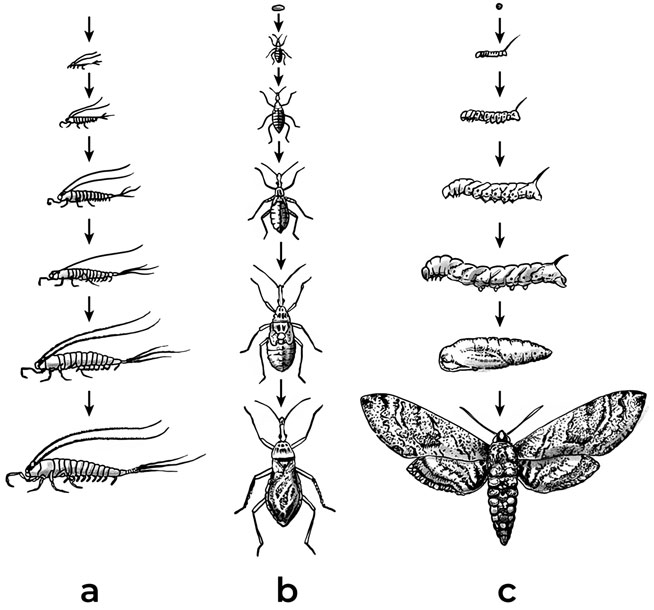
Harman first traces the history of the very idea of metamorphosis. The word metamorphosis was first coined around 47 BCE by the poet Ovid, who used it as a poetic device to tell stories of gods and humans shifting shapes. “Things merely vary and change appearance. What we call birth is merely becoming a different entity; what we call death is ceasing to be the same.” Ovid’s words capture both the depth and mystery that metamorphosis inspires. The word itself, derived from Greek roots meaning “changing form,” later migrated from myth into science. As a historian of science, Harman follows it from Aristotle through early naturalists to modern biologists, showing how metamorphosis has never been only a biological puzzle—it has also been a cultural, philosophical, and spiritual question. Across the book, he moves from the familiar (caterpillars and butterflies, tadpoles and frogs) to the uncanny (immortal jellyfish that can revert to earlier stages).
Early naturalists believed life could arise spontaneously from mud, wind, or rotting meat, and Harman recounts the flawed but earnest efforts of early thinkers to explain cocoons, chrysalides, and the origins of insects. He also writes about German entomologist and naturalist Maria Sibylla Merian, whose careful observations revealed that caterpillars and butterflies were the same organism passing through stages of transformation. Her 17th-century illustrations proved that metamorphosis was a natural, continuous process, disproving spontaneous generation and changing how the world saw growth and identity.
There are several examples from the natural world that highlight philosophical questions associated with metamorphosis. The mayfly, which lives only one day as an adult, raises questions about the meaning of life compressed into fleeting time. Jellyfish, which can revert to a younger state, challenge assumptions about aging and mortality. The caterpillar and butterfly raise another central question: Are they two different organisms, or the same being in two stages of life? Harman’s presentation suggests that these transformations are more than mere curiosities but rather metaphors for human existence.
In his recounting of the history of our long efforts to understand metamorphosis, Harman portrays scientists not as flawless geniuses, but as real people shaped by their times. For example, early researchers often clung to mistaken ideas about spontaneous generation or mystical forces in nature. Even Ernst Haeckel, whose bold embryological theories captivated the 19th century, was not immune to error. His claim that “ontogeny recapitulates phylogeny”—that an embryo’s development mirrors the evolutionary history of its species—was elegant but flawed. To fit his theory, he exaggerated embryo drawings, revealing both creativity and bias. He is described not as a villain, but as an example of how brilliant minds can be swayed by cultural fashions, showing that science often progresses through missteps as much as breakthroughs—perhaps a metamorphosis of its own.
As Harman carries the story forward, he explores how questions about metamorphosis helped create entire scientific fields. Developmental biology, evolutionary theory, and modern medical science all emerged partly from studying transformation. In 1874, Ernst Haeckel’s book The Evolution of Man famously illustrated developing embryos of a fish, salamander, turtle, chicken, pig, calf, rabbit, and human, suggesting that early developmental stages were nearly identical in all creatures and pointing to a simple common ancestor in the distant past. Julius Kollmann’s idea of “neoteny”—the retention of juvenile traits into adulthood—added new complexity to how scientists understood growth and change.
Finally, Harman braids the history of science with broader human concerns, writing as a historian, philosopher, and even memoirist. As a father-to-be, he reflects on how metamorphosis speaks to the transformations of human life, including birth, puberty, aging, and other shifting roles. The tension between body and identity becomes a recurring theme: Does an organism continue through radical change, or does each transformation create a new being? With questions such as these, Harman makes the science feel deeply personal.
Metamorphosis: A Natural and Human History is more than a book about insects and the evolution of science. It is a meditation on change itself—biological, cultural, and personal. By tracing 2,400 years of thought, Harman shows that metamorphosis fascinates us not only because it is scientifically puzzling, but also because it reflects something universal: our desire to understand who we are as we move through life’s stages. It is a book that reminds us that transformation is both a natural process and a part of human existence.
American Scientist Comments and Discussion
To discuss our articles or comment on them, please share them and tag American Scientist on social media platforms. Here are links to our profiles on Twitter, Facebook, and LinkedIn.
If we re-share your post, we will moderate comments/discussion following our comments policy.